



TL;DR
AI could add £23 billion a year to Scotland’s GDP. That’s the headline figure behind a new five-year national strategy, launched in March 2026, that sets out how Scotland will use artificial intelligence to grow its economy, improve public services, and create new jobs. It’s built around an eight-layer “AI Stack” framework, backed by billions in private investment, and comes with 10 concrete actions to be delivered by March 2027.
The Launch
On Friday 20 March 2026, the Scottish Government officially launched its AI Strategy 2026 - 2031 at the Edinburgh Futures Institute, Edinburgh. The event, brought together policy makers, business leaders, academics, and tech professionals for what was billed as a landmark moment for Scotland’s digital future.
The strategy was introduced by Deputy First Minister Kate Forbes MSP and Minister for Business and Employment Richard Lochhead MSP. The details were presented by Colin Cook, Director of Economic Development at the Scottish Government. The strategy was developed with input from over 100 experts, business leaders, academics, and third-sector organisations, guided by the AI Sub-group of the Scottish Technology Council.
Delivery will be driven by AI Scotland, a new national transformation programme led by the Scottish Government in partnership with The Data Lab, Scottish Enterprise, Highlands and Islands Enterprise, and South of Scotland Enterprise. Working across business, academia, and the public sector, AI Scotland will coordinate the country’s collective efforts. An early priority is the launch of a refreshed AI Adoption Programme aimed at SMEs, building on a £1 million pilot from 2025.
The strategy’s core purpose is straightforward: use AI to drive responsible and inclusive economic growth while making a positive difference at every level of Scottish society. It’s not just a vision document. It comes with defined outcomes, a phased action plan, and an independent Expert Advisory Board to ensure accountability. The plan will be delivered in three phases: Phase 1 actions are already in motion, Phase 2 updates will follow in 2027, and Phase 3 in 2029.
But what does “responsible AI” actually mean here? The strategy is guided by the OECD’s five principles for trustworthy AI and Scotland’s commitment to Fair Work. In practice, that means every programme under the AI Scotland banner must promote ethical deployment, address barriers to adoption, support high-potential companies to scale, and improve access to quality data, all while maintaining public trust.
How will we know if it’s working? The government has defined clear outcomes for each of the eight layers of the strategy, with regular progress reports planned throughout the five-year lifecycle. An Expert Advisory Board made up of AI champions, business leaders, and technical experts will evaluate activities and guide future priorities.
10 Key Stats From the Strategy
£23 billion estimated additional annual GDP that AI could generate for Scotland by 2035. For context, that’s roughly comparable to the entire output of Scotland’s financial services sector.
£140.75 billion potential cumulative GDP boost between 2025 and 2035. That would represent a transformative shift in the size of Scotland’s economy over a single decade.
296 AI-focused companies currently operating in Scotland, spanning start-ups, scale-ups, research institutions, and consultancies.
61.9% proportion of Scottish SMEs not yet using AI technologies. This is the adoption gap the strategy is designed to close.
5,700 AI-related job postings across Scotland between July 2024 and June 2025, signalling strong and growing employer demand.
£8 billion+ private investment backing Scotland’s first AI Growth Zone in North Lanarkshire, one of the largest AI infrastructure commitments in Europe.
3,400+ new jobs the Lanarkshire AI Growth Zone is expected to create, including 800 high-value AI and digital infrastructure roles.
38.4 TWh renewable electricity produced in Scotland in 2024, a record high and a core part of the country’s pitch to global data centre investors.
50+ companies in Scotland’s semiconductor cluster, with annual turnover exceeding £1.2 billion across the full supply chain.
Quick Reference: 10 Actions at a Glance
These are the ten priority actions the Scottish Government has committed to delivering before March 2027. Each one is explored in more detail within the AI Stack sections below.
Position AI Scotland as the national flagship delivery programme
Appoint AI Industry Champions with an independent Expert Advisory Board
Launch a nationwide public engagement programme to build trust
Implement a trusted framework for AI in health and social care
Roll out a revitalised SME AI adoption programme with a new AI Leadership Academy
Establish a Future Jobs Panel for workforce planning
Pilot an AI Scale-up Accelerator for high-growth companies
Launch an AI innovation programme for public services
Promote Scotland as a green data centre hub and maximise the Lanarkshire AI Growth Zone
Launch a data matchmaking pilot for public-sector datasets
Phase 2 updates follow in 2027 and Phase 3 in 2029, ensuring the plan adapts as technology evolves.
The AI Stack: Scotland’s Framework Explained
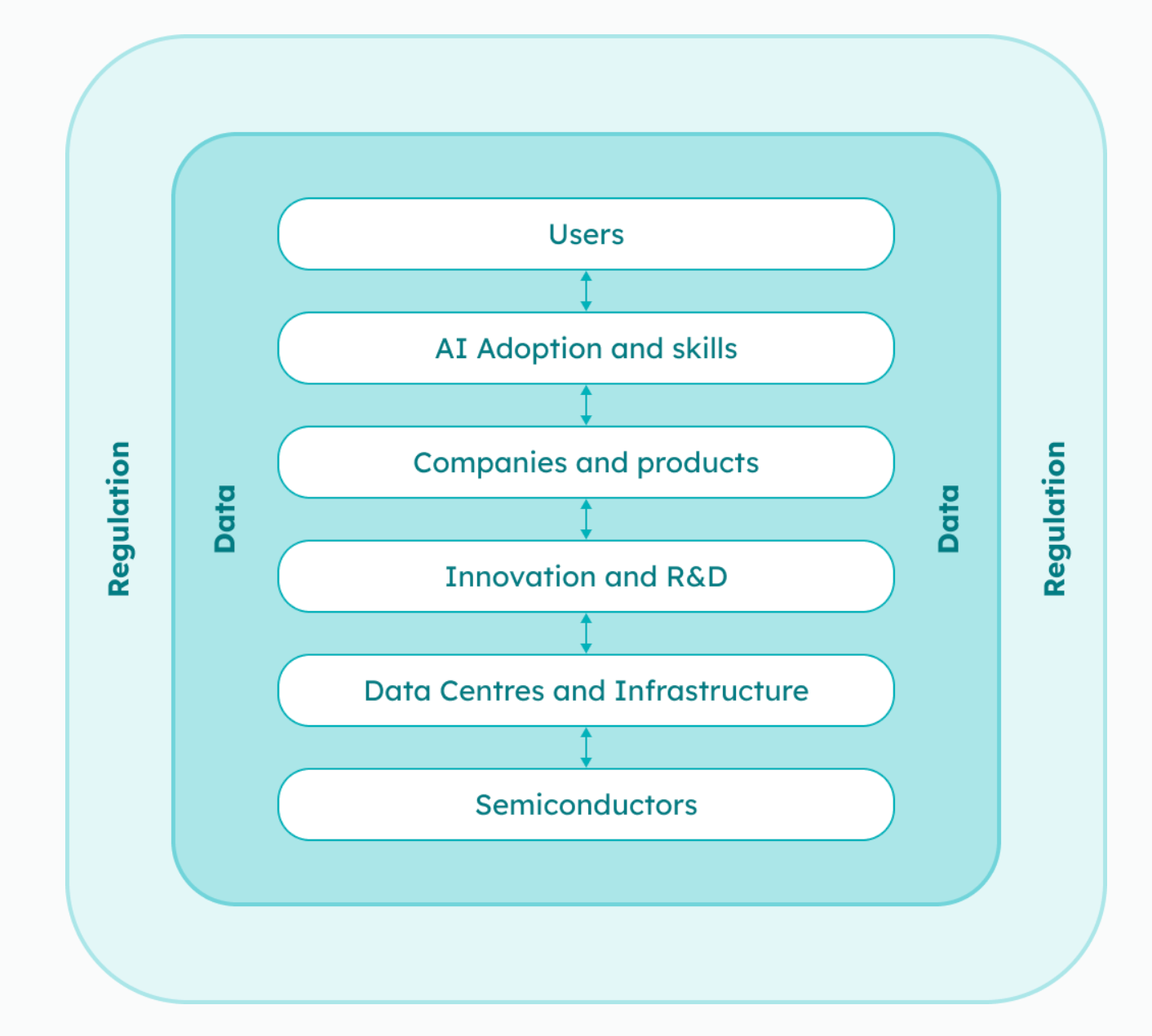
At the heart of the strategy sits the “AI Stack”, a model of eight interconnected layers that represent everything needed for a healthy AI ecosystem. These layers aren’t ranked by importance; they all depend on each other. Data and Regulation are shown as “encircling” layers, sitting around and within all other layers.
Layer 1: Users
This is about everyday people: citizens who interact with AI through public services, healthcare, and digital platforms. The goal by 2031 is that people across Scotland understand where AI is being used in services that affect them, feel confident engaging with it, and trust that it’s being used fairly. Non-digital access to services will still exist. AI supplements; it doesn’t replace.
Key actions by 2027:
Establish an independent Expert Advisory Board
Launch a nationwide engagement programme to build public trust
Implement a trusted framework for safe AI in health and social care
Promote open-access AI literacy materials
Increase visibility of AI use across the public sector
Work with public bodies to strengthen ethical and inclusive approaches to AI governance
Q&A
Will AI replace how I access public services? No. You’ll still be able to access services the way you do now. AI is being introduced to speed things up and reduce paperwork, not to remove the human option.
How will I know when AI is involved in decisions about me? The government says it will make it clearer when and how AI is being used in public services, including what safeguards are in place. The aim is full transparency.
What about people who aren’t tech-savvy? Free, open-access learning materials are planned, alongside a nationwide engagement programme designed to reach people of all ages, backgrounds, and locations.
Layer 2: Adoption and Skills
Nearly two-thirds of Scottish SMEs aren’t using AI yet. This layer tackles that head-on with practical support: a revitalised national adoption programme, a new AI Leadership Academy for business leaders, a standardised AI readiness tool, and expanded modular training focused on real use cases. A Future Jobs Panel will map out how AI reshapes the workforce and guide national skills planning.
Key actions by 2027:
Roll out the revitalised national AI adoption programme
Pilot the AI Leadership Academy for SME leaders
Introduce a standardised AI readiness tool for SMEs and public bodies
Expand short, modular AI literacy training on practical use cases and ethics
Establish the Future Jobs Panel to assess AI’s workforce impact
Q&A
I run a small business. What support is available for me? Quite a lot, actually. A refreshed national programme will offer hands-on guidance tailored to SMEs. There’s a new Leadership Academy to help business owners get to grips with AI, a readiness tool to show you where you stand, and short training courses on practical use cases.
Will AI take my job? The strategy is built around Fair Work principles. Rather than replacing people, the focus is on helping workers develop new skills so they can benefit from the changes AI brings. A new Future Jobs Panel will track the impact and guide national planning.
What is the AI readiness tool? Think of it as a health check for your organisation. It’s a standardised assessment that helps SMEs, social enterprises, and public bodies understand how prepared they are for AI and what to focus on next.
Layer 3: Companies and Products
Scotland is home to around 296 AI companies, from early start-ups to globally recognised scale-ups like Edinburgh-based Wordsmith AI, which reached a $100 million valuation just 18 months after launch. This layer aims to build a pipeline of high-growth AI firms capable of reaching billion-pound valuations, supported by better access to compute power, talent, and international investment.
Key actions by 2027:
Pilot an AI Scale-up Accelerator connecting high-growth companies with experienced entrepreneurs and investors
Deliver a national stakeholder event for Scotland’s AI ecosystem
Undertake a national assessment of AI company needs and scaling barriers
Increase accessibility of compute power for Scottish AI companies
Strengthen international investor engagement via Techscaler and public agencies
Q&A
Can Scottish AI companies compete on the global stage? That’s the ambition. With 296 AI companies already here and a growing track record of fast-scaling start-ups, the ecosystem has real momentum. The strategy backs this with a Scale-up Accelerator, international investor engagement, and better access to computing infrastructure.
What about access to computing power? This is a big barrier for smaller firms. The government plans to work with existing asset owners to make compute capacity more accessible and affordable for Scottish AI companies.
Why does Scotland need its own AI companies? Control. Home-grown AI companies help protect sensitive data in areas like health and public services. They also keep skilled workers in Scotland and support the wider ecosystem of universities, investors, and start-ups.
Layer 4: Innovation, Research and Development
Scotland’s universities are world-class in AI research, but too little of that brilliance is making it into commercial products. This layer focuses on closing the gap between lab and market through a new Venture Creator model for university commercialisation, a national cluster scheme, and stronger pathways from research to spin-outs. AI is already delivering remarkable results in Scottish healthcare: the NeurEYE project is using nearly 1 million retinal scans to detect dementia risk, and NHS Grampian’s GEMINI project used AI to detect 12% more breast cancers than standard screening.
Key actions by 2027:
Launch an AI innovation programme for public services
Establish a national cluster scheme with AI as a critical enabling technology
Develop financial support for clusters to compete internationally
Pilot the Venture Creator model for university commercialisation
Strengthen the research commercialisation pipeline via the Scottish Spin-out Report
Q&A
What’s a “Venture Creator”? It’s a new model for turning university research into businesses. Instead of leaving academics to figure out commercialisation alone, it brings together funding, mentoring, and business expertise under one roof.
Is Scottish AI research any good? More than good. Scotland’s universities perform strongly on the international stage in AI and related disciplines. The problem isn’t the quality of research; it’s that not enough of it is being turned into products, services, and companies.
What real-world impact is AI already having in Scotland? Several projects stand out. The NeurEYE project is using retinal scans to spot early signs of dementia. NHS Grampian’s GEMINI project found 12% more breast cancers than standard practice. SPARRAv4 analyses over 4.8 million health records to predict emergency hospital admissions. And the AI-TRiPS clinical trial is one of the world’s first randomised evaluations of AI in emergency trauma care.
Layer 5: Data Centres and Infrastructure
AI needs massive computing power, and that needs to be hosted somewhere. Scotland is positioning itself as a green data centre hub, leveraging its record-breaking renewable energy output and water infrastructure. Key investments include a £15 billion AI industrial park in North Ayrshire with up to 6,400 GPUs, and a £2.5 billion CoreWeave and DataVita renewable-powered compute campus in Lanarkshire.
Key actions by 2027:
Ensure effective delivery of the Lanarkshire AI Growth Zone
Explore a dedicated AI Accelerator linked to the Growth Zone
Progress the pipeline of data centre investment opportunities
Identify and mobilise heat offtake opportunities on data centre sites linked to district heat networks
Publish guidance on what constitutes a “green” data centre
Q&A
Why Scotland for data centres? Scotland produced a record 38.4 TWh of renewable electricity in 2024, with 26.4 GW of new capacity in the pipeline. That’s one of the largest renewable pipelines in Europe relative to population. For global investors, AI powered by clean energy in a politically stable country is a strong proposition.
What about the environmental impact? It’s being taken seriously. Scottish Water is advising on sustainable water use, including wastewater reuse and closed-loop cooling systems. The government will also publish guidance on what qualifies as a “green” data centre, and is exploring ways to reuse heat from data centre sites to warm nearby homes through district heating networks.
What is distributed compute and why does it matter? Instead of concentrating all processing in a handful of giant data centres, distributed compute spreads it across smaller sites around the country. Scotland’s national fibre backbone makes this possible, and it offers practical benefits: faster deployment, lower latency for AI tasks, and opportunities to reuse waste heat locally.
Layer 6: Semiconductors
Every AI system runs on chips, and the global race to secure semiconductor supply chains is intensifying. Scotland already has skin in this game: a Critical Technologies supercluster with over 50 companies, annual turnover exceeding £1.2 billion, and specialisms in image sensors, AI architectures, and photonics. The ambition is to differentiate globally by leading in low-energy, semiconductor-enabled data centre and edge-AI technologies.
Key actions by 2027:
Engage the Critical Technologies Supercluster Advisory Board to identify strengths and coordinate R&D
Enable growth of high-potential AI hardware spin-outs
Align future workforce planning with the needs of advanced technology industries
Q&A
How big is Scotland’s semiconductor industry? Bigger than many people realise. Over 50 companies span the full supply chain, from research through to advanced packaging, with combined annual turnover above £1.2 billion and multiple open-access industrial facilities.
What makes Scotland different in this space? Niche strengths. Scotland isn’t trying to compete with Taiwan on volume manufacturing. Instead, it’s focusing on photonics, chip design, power electronics, and advanced packaging, areas where focused innovation can deliver outsized returns and sovereign capability.
Layer 7: Data
Good AI needs good data, and right now Scotland’s public sector data is too fragmented and too hard to access. This layer tackles that with a data matchmaking pilot to open up trusted public-sector datasets for innovation, a programme to identify what’s blocking access, and a joint leadership group with Local Government to drive a more coordinated approach.
Key actions by 2027:
Launch the data matchmaking pilot for public-sector datasets
Identify barriers and enablers affecting public sector data access for AI
Launch an AI innovation programme for public services
Establish a joint data leadership group with Local Government
Q&A
What is the data matchmaking pilot? It’s a new programme that will connect organisations with trusted public-sector datasets they can use to develop AI-driven solutions. Think of it as a facilitated introduction between the people who hold the data and the people who can put it to good use.
Will my personal data be at risk? No. Data shared through these programmes will be anonymised and governed by strict security frameworks. The strategy is built on principles of transparency, safety, and public benefit.
Why does data matter so much for AI? Because AI learns from data. If public sector data stays locked in silos, Scotland can’t build the AI tools that could improve NHS services, make government more efficient, or drive new research. Unlocking that data safely is one of the biggest practical challenges the strategy tries to solve.
Layer 8: Regulation
Rules matter. Without clear regulation, businesses don’t know what’s allowed, investors hesitate, and the public loses trust. Scotland’s approach is guided by OECD principles and advocates for UK-level legislation that aligns with the EU AI Act, which is crucial for Scottish businesses that trade with European markets. The government will also review whether additional Scotland-specific safeguards are needed in devolved areas.
Key actions by 2027:
Advocate for UK AI regulation aligned with OECD principles and the EU AI Act
Review the scope for regulation in devolved areas where sector-specific safeguards may be needed
Publish a report on the requirements for AI regulation in Scotland
Q&A
Will regulation slow down innovation? The strategy argues the opposite. Clear rules give businesses and investors the confidence to commit. And aligning with international standards, particularly the EU AI Act, keeps European markets open for Scottish companies rather than creating barriers.
Is there going to be Scotland-specific AI regulation? Possibly. The government will review whether devolved areas need additional safeguards and will publish a report before 2027.
What are regulatory “sandboxes”? They’re controlled environments where new regulations can be tested before being rolled out widely. The strategy references the Financial Conduct Authority’s existing sandbox and the UK Government’s proposed “AI Growth Lab” as models Scotland could learn from.
More Questions and Answers
What sectors will benefit most from this strategy? Six priority sectors are identified: Healthcare and Life Sciences, Advanced Manufacturing and Robotics, Financial Services and FinTech, Renewable Energy and Climate Science, Space and Satellite Technology, and Creative Industries.
What is AI Scotland, and how is it different from the strategy itself? The strategy is the plan. AI Scotland is the team that delivers it. It’s a new national programme led by the Scottish Government alongside The Data Lab, Scottish Enterprise, Highlands and Islands Enterprise, and South of Scotland Enterprise.
What organisational form will AI Scotland take? That’s still being decided. In the first year, an Expert Advisory Board will develop a business case. Options include a cluster management organisation or a non-profit company.
What risks does the strategy acknowledge? Seven: privacy and data protection, workforce disruption, environmental impacts of AI energy and water use, pressure on renewable energy capacity, gender inequality being amplified by AI systems, sovereign infrastructure concerns, and sector-specific disruption to business models and skills demand.
How does the strategy address environmental concerns? Through renewable-powered computing, water-secure data centre design, heat reuse from data centres, energy-aware planning, and published guidance on what constitutes a “green” data centre.
How does this strategy fit with Scotland’s wider economic plans? It sits within the National Strategy for Economic Transformation (NSET) and Scotland’s National Innovation Strategy 2023 to 2033. AI is positioned as a central enabler of Scotland’s shift towards a fairer, greener, and more innovative economy.
Is this Scotland’s first AI strategy? No. The first was published in 2021 and focused on establishing principles for trustworthy, ethical AI. This 2026 strategy builds on that foundation with a structured delivery framework (the AI Stack), a dedicated delivery body (AI Scotland), and a phased action plan with defined outcomes.
What major AI infrastructure investments are planned? Three headline investments: a £15 billion AI Pathfinder project in North Ayrshire with up to 6,400 GPUs, a £2.5 billion CoreWeave and DataVita renewable-powered campus in Lanarkshire, and a Lenovo AI Research and Development Hub in Edinburgh.
How is AI being used in Scottish financial services? Across fraud detection, customer support, compliance, and investment analysis. Key organisations include FinTech Scotland, the Financial Regulation Innovation Lab, the Finance and Health Lab, and the Smart Data Foundry.
Where can I get involved or find out more? Visit aiscotland.scot for updates, programmes, and engagement opportunities. The government has also committed to a nationwide engagement programme designed to hear public concerns and build confidence.
Additional Resource Scotland’s AI Strategy 2026–2031: 50 Questions Answered
Final Words
There is a lot to like about this strategy. It’s well-structured, specific, and refreshingly honest about the gaps Scotland needs to close, from the 62% of SMEs not yet using AI to the fragmented state of public sector data. The eight-layer AI Stack is a genuinely useful framework, and the commitment to publishing phased updates in 2027 and 2029 means the strategy has a built-in mechanism for course correction.
The delivery partnerships are credible. Having The Data Lab, Scottish Enterprise, Highlands and Islands Enterprise, and South of Scotland Enterprise working alongside the government gives AI Scotland a practical reach that a policy document alone could never achieve. The ten priority actions are concrete, time-bound, and measurable, which is more than many national strategies can claim.
Of course, strategies are only as good as their execution. The real test will come in the next 12 to 18 months. Will the AI Leadership Academy attract SME leaders who wouldn’t otherwise engage with AI? Will the data matchmaking pilot unlock genuinely useful datasets, or get bogged down in governance? Will the Lanarkshire Growth Zone deliver the promised 3,400 jobs, and will those jobs benefit local communities as well as global tech firms? These are the questions that will determine whether this strategy becomes a turning point or a shelf decoration.
For now, though, the ambition and the architecture are in place. Whether you’re a business owner weighing your first AI investment, a citizen wondering what this means for your GP practice, or a researcher looking to turn your work into a company, this strategy is speaking directly to you. It deserves your attention.