



In March 2026, the Scottish Government published its most ambitious technology policy document to date — a five-year national AI strategy that maps out how Scotland plans to become a globally competitive AI nation while keeping ethics, sustainability, and inclusivity at its core.
The strategy covers everything from a potential £23 billion annual GDP boost by 2035 to renewable-powered data centres, a new national AI programme called “AI Scotland,” and sector-specific plans spanning healthcare, financial services, semiconductors, and creative industries. It was shaped by input from over 100 experts, business leaders, academics, and third-sector organisations.
Whether you’re a business leader weighing up AI investment, a policymaker tracking regulatory signals, a researcher looking for funding and collaboration cues, or simply someone who wants to understand how AI will shape Scotland’s economy and public services over the next five years — this FAQ breaks down the full 58-page document into 50 clear, direct answers.
TL;DR
Scotland’s AI Strategy 2026–2031 is built around an eight-layer “AI Stack” framework and sets out ten priority actions to be delivered by March 2027. The headline numbers: AI could add £23 billion in annual GDP by 2035, yet only 30.7% of Scottish businesses currently use AI. The strategy launches “AI Scotland” as a national coordination programme, backs major data centre and compute infrastructure investment — including a £15 billion AI Pathfinder project in North Ayrshire and over £8 billion in the Lanarkshire AI Growth Zone — establishes a Future Jobs Panel and AI Leadership Academy for workforce readiness, and pushes for UK-level regulation aligned with the EU AI Act. Six priority sectors are targeted — healthcare, advanced manufacturing, financial services, renewable energy, space tech, and creative industries. Sustainability is a major theme, with Scotland positioning its record-breaking 38.4 TWh of renewable electricity generation as the backbone of a “Scottish Green Compute” proposition. Public trust will be addressed through a nationwide engagement programme, and non-digital routes to public services will remain available.
General Overview
1. What is Scotland’s AI Strategy 2026–2031?
Scotland’s AI Strategy 2026–2031 is a national policy document published by the Scottish Government in March 2026. Its purpose is to harness the potential of artificial intelligence to drive responsible and inclusive economic growth across Scotland and make a positive difference at every level of society. The strategy covers a five-year period and is structured around an “AI Stack” model with eight interconnected layers.
2. Who published Scotland’s AI Strategy?
The strategy was published by the Scottish Government. The foreword was jointly written by Kate Forbes MSP (Deputy First Minister and Cabinet Secretary for Economy and Gaelic) and Richard Lochhead MSP (Minister for Business and Employment).
3. What is the main purpose of the strategy?
The stated purpose is: to harness the potential of AI to drive responsible and inclusive growth across Scotland’s economy and make a positive difference at every level of society. It demands an ethical approach to AI development and application, with a focus on improving lives, transforming productivity, stimulating economic opportunity, and improving the quality and efficiency of public services.
4. What time period does the strategy cover?
The strategy runs from 2026 to 2031. It will be delivered in three phases: Phase 1 actions are outlined in this document, Phase 2 updates will be published in 2027, and Phase 3 updates in 2029.
5. How was the strategy developed?
The strategy was developed through widespread engagement across Scotland, including consultations with businesses, Industry Leadership Groups, universities and colleges, innovation centres, and enterprise and skills agencies. Over 100 experts, business leaders, academics, and third-sector organisations participated in consultation workshops. The work was guided by the AI Sub-group of the Scottish Technology Council.
The AI Stack Framework
6. What is the “AI Stack”?
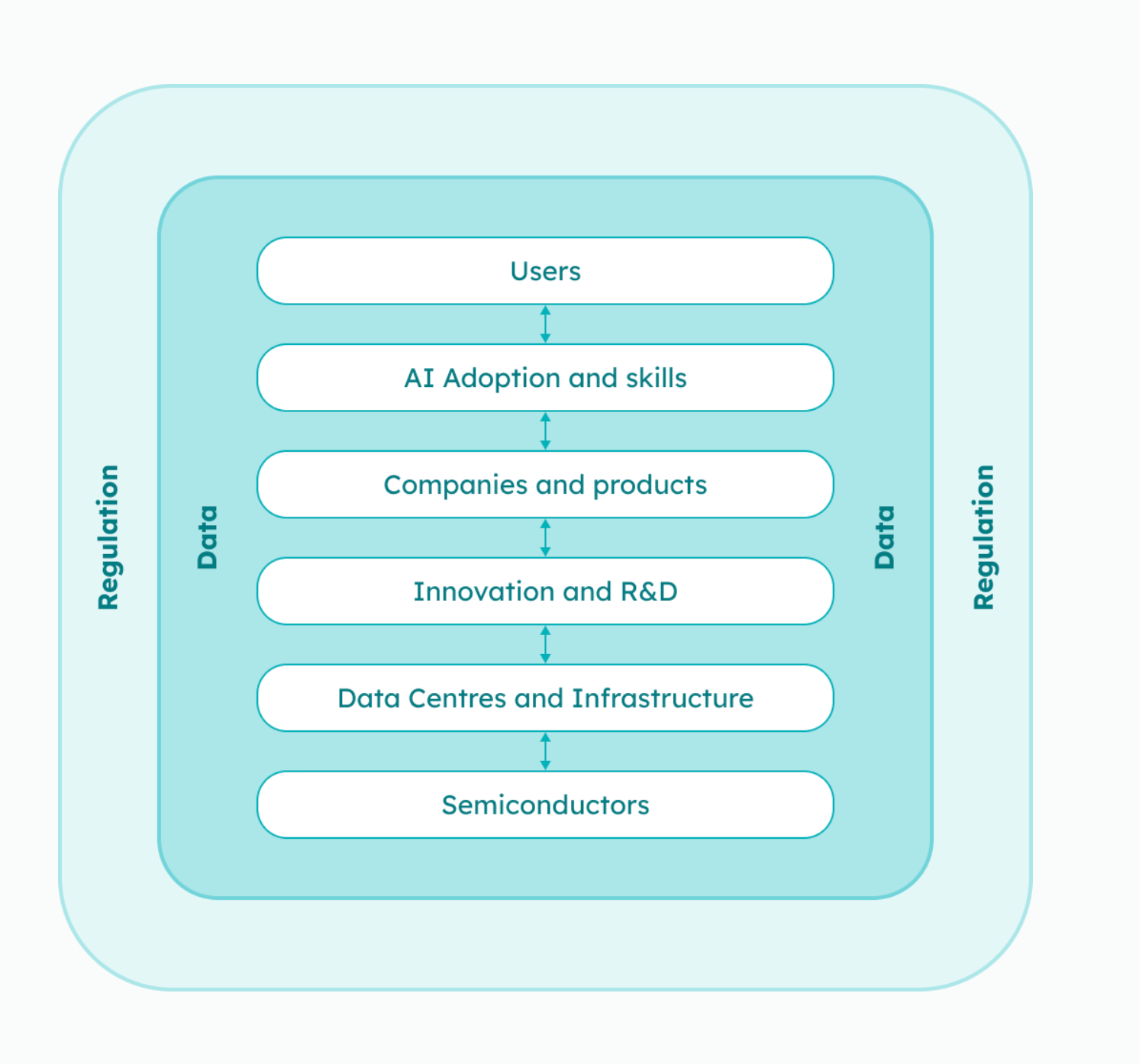
The AI Stack is the organising framework at the heart of the strategy. It describes eight non-hierarchical layers that represent the full AI ecosystem and must work together to deliver social and economic good. The layers are: Users, Adoption and Skills, Companies and Products, Innovation Research and Development, Data Centres and Infrastructure, Semiconductors, Data, and Regulation.
7. Are the layers of the AI Stack ranked by importance?
No. The position of each layer does not reflect its value or importance. All layers have interdependencies and interact with all other layers. Data and Regulation are shown as “encircling” layers to illustrate that they sit around, as well as within, all other layers.
8. How does the AI Stack relate to the strategy’s outcomes?
Each layer of the AI Stack has its own case for change, specific actions, and defined outcomes to be achieved by 2031. If all actions and outcomes are delivered across every layer, the strategy’s overall purpose will be achieved.
Key Actions and Delivery
9. What are the ten key actions to be completed by March 2027?
The ten priority actions are:
(1) Position AI Scotland as the national flagship programme,
(2) Appoint AI Industry Champions with an Expert Advisory Board,
(3) Launch a nationwide engagement programme for public trust,
(4) Implement a framework for safe AI use in health and social care,
(5) Roll out a revitalised national AI adoption programme for SMEs including an AI Leadership Academy,
(6) Establish a Future Jobs Panel,
(7) Pilot an AI Scale-up Accelerator,
(8) Launch an innovation programme applying AI to public services,
(9) Promote Scotland as a green data centre hub and maximise the Lanarkshire AI Growth Zone,
(10) Launch a data matchmaking pilot for public-sector datasets.
10. What is AI Scotland?
AI Scotland is a new national transformation programme led by the Scottish Government and a consortium of partners, including The Data Lab, ScotlandIS, and Enterprise agencies. It will coordinate and amplify Scotland’s collective efforts to implement the strategy’s actions, working across business, academia, and the public sector.
11. What organisational form will AI Scotland take long-term?
In the first year, an Expert Advisory Board will advise on the development of a comprehensive business case for AI Scotland’s long-term organisational model. Potential models under consideration include a cluster management organisation (CMO) or a non-profit company (NPC).
12. What is the role of the Expert Advisory Board?
The Expert Advisory Board will evaluate AI Scotland’s activities, provide strategic advice, and guide the development of future programmes and interventions. Membership will include AI champions from key sectors and regions, alongside business leaders and technical experts.
Economic Impact
13. What is the estimated economic value of AI for Scotland?
GC Insight has estimated that, with the right investment and leadership, AI could generate more than an additional £23 billion in annual GDP by 2035, with a potential cumulative additional GDP of £140.75 billion over the period 2025 to 2035.
14. How many AI-focused companies are there in Scotland?
Independent assessments indicate that Scotland is home to an estimated 296 AI-focused companies, spanning emerging start-ups, scale-ups, research institutions, innovation centres, and specialist technical consultancies.
15. What is the current level of AI adoption among Scottish businesses?
As of March 2025, 61.9% of Scottish SMEs reported they are not using AI technologies, according to the Business Insights and Conditions Survey (BICS). Only 30.7% of businesses across Scotland currently use AI.
16. What is the Lanarkshire AI Growth Zone?
Scotland’s first AI Growth Zone in North Lanarkshire is backed by over £8 billion of private investment and designed in partnership with DataVita and CoreWeave. It is set to deliver more than 3,400 new jobs, including 800 high-value AI and digital infrastructure roles, and will include a community fund to support local programmes over the next 15 years.
Skills and Workforce
17. How many AI job postings were there in Scotland recently?
Between July 2024 and June 2025, there were 5,700 job postings requiring at least one AI skill across Scotland.
18. What is the Future Jobs Panel?
The Future Jobs Panel will be established to assess AI’s workforce impact and guide national skills planning. It will help ensure Scotland’s workforce can navigate the opportunities and changes AI brings.
19. What is the AI Leadership Academy?
A new AI Leadership Academy will be piloted for leaders of Scottish SMEs as part of the revitalised national AI adoption programme. It aims to build leadership capacity to understand and respond to the potential of AI and the need for change.
20. How does the strategy address skills shortages?
The strategy addresses skills shortages through expanded modular AI literacy training, a standardised AI readiness tool for SMEs and public bodies, a Future Jobs Panel, the AI Leadership Academy, and alignment of skills investment with strategic national and regional needs. Fair Work principles are embedded throughout.
21. What is the SME AI Adoption Programme?
The SME AI Adoption Programme was a £1 million initiative launched in the Programme for Government 2025–26, delivered in collaboration with Scotland’s enterprise agencies and The Data Lab. More than 500 SMEs engaged with it, over 80 firms identified AI use cases, 120+ senior leaders participated in leadership development, and 160+ companies received hands-on assistance.
22. How does the strategy incorporate Fair Work principles?
The strategy embeds Scotland’s Fair Work principles throughout, ensuring that AI adoption involves workers, promotes upskilling, and supports improved job quality and security. All workforce changes driven by AI must align with these principles.
Research and Innovation
23. What is Scotland’s standing in AI research?
Scotland is recognised as a global leader in AI research. Five Scottish universities were placed in the UK’s top 30 for AI research output in 2025. The country hosts ARCHER2 (the UK’s national supercomputer) and will host the new £750 million UK National Supercomputing Centre at the University of Edinburgh.
24. Who are Scotland’s AI pioneers?
The strategy highlights five notable AI pioneers with Scottish connections: Donald Michie (founded Europe’s first AI research group at Edinburgh in 1963), Geoffrey Hinton (completed his PhD at Edinburgh, won the 2024 Nobel Prize in Physics), Joanna Bryson (Edinburgh graduate, co-authored the UK’s first national AI ethics framework), John Giannandrea (Strathclyde graduate, led AI at Google then Apple), and Amanda Askell (Dundee graduate, co-authored the GPT-3 paper and helped create Constitutional AI at Anthropic).
25. What is the National Robotarium?
Based at Heriot-Watt University, the National Robotarium drives breakthroughs in medical robotics, offshore robotics, and autonomous systems. It has incubated 14 robotics companies in its first few years, operating in a sector projected to grow to £218 billion globally by 2030.
26. How will research be better commercialised?
The strategy commits to piloting a new approach to university commercialisation through a “Venture Creator” model, bringing together all the essential elements of commercialisation. It will also progress initiatives from the Scottish Spin-out Report and establish a national cluster scheme.
27. What is the planned national cluster scheme?
The Scottish Government will establish a national cluster scheme, aligning AI as a critical enabling technology across all clusters, and develop financial support and guidance to enable clusters to emerge, grow, and compete internationally.
Infrastructure and Energy
28. What renewable energy advantages does Scotland have for AI?
Scotland produced 38.4 TWh of renewable electricity in 2024 — its highest annual total ever — representing a 13.2% increase on the prior year. It has 26.4 GW of new renewable capacity in planning or consented pipelines, one of the largest in Europe relative to population. Scotland also has established onshore and offshore wind sectors and first-mover advantage in floating offshore wind.
29. What major AI infrastructure investments are planned?
Key investments include: a £15 billion AI Pathfinder project in North Ayrshire creating a large-scale AI industrial park with up to 6,400 GPUs; a £2.5 billion CoreWeave and DataVita renewable-powered AI compute campus in Lanarkshire; and a Lenovo AI Research and Development Hub in Edinburgh.
30. What is Scotland’s approach to sustainable data centres?
Scotland is developing a “Scottish Green Compute” proposition — AI powered by clean energy. The strategy includes publishing guidance on what constitutes a “green” data centre, exploring “Green AI-Ready” planning zones, mobilising heat offtake opportunities linked to district heat networks, and promoting water-resilient design through Scottish Water advisories.
31. What is distributed compute and why does it matter?
Distributed compute spreads processing across multiple geographically dispersed sites rather than concentrating it in hyperscale data centres. Scotland’s national fibre backbone investment has enabled this potential. Distributed compute offers quicker deployment, benefits around AI inference capabilities, and heat reuse opportunities.
32. How are grid connection challenges being addressed?
While electricity grid policy is reserved to the UK Government, the Scottish Government is engaging with the National Energy Systems Operator (NESO) and the UK Government’s Connections Accelerator Service to enable projects to be connected as soon as feasible through NESO’s Grid Connection Reform Process.
Data
33. What is the strategy’s approach to public sector data?
The strategy recognises that Scotland’s public sector data is often fragmented and difficult to access. It commits to launching a data matchmaking pilot, identifying barriers to data access for AI, launching an AI innovation programme for public services, and delivering a more coordinated public sector approach through a joint leadership group with Local Government.
34. What is the data matchmaking pilot?
The data matchmaking pilot will enable organisations to access trusted public-sector datasets to support data-driven innovation. It is one of the ten priority actions to be completed before March 2027.
35. What are the data outcomes sought by 2031?
By 2031, the strategy seeks: collective leadership creating a mature public sector data ecosystem; secure, well-maintained data assets guided by transparency and safety principles; AI-ready public sector data deployed responsibly; and secure, anonymised datasets available across organisational boundaries for research and innovation.
Regulation
36. What is Scotland’s regulatory approach to AI?
Scotland’s approach is guided by the OECD’s five values-based principles for the responsible stewardship of trustworthy AI. The strategy advocates for UK-level regulation that places these principles on a statutory footing and enables alignment with the EU AI Act to maintain access to European markets.
37. How does the strategy relate to the EU AI Act?
The Scottish Government intends to advocate for UK-level AI regulation that addresses the need for Scottish businesses to access European markets, investment, and opportunities. The strategy notes that the EU AI Act imposes statutory obligations on providers of general-purpose AI models and that alignment would benefit Scottish companies operating in European markets.
38. What is meant by “sandboxes” in the context of AI regulation?
Sandboxes are controlled environments in which changes to regulations can be tested. The strategy references the Financial Conduct Authority’s existing regulatory sandbox and the UK Government’s proposed “AI Growth Lab” as models that Scotland may learn from and innovate upon.
39. Will there be Scotland-specific AI regulation?
The Scottish Government will review and report on the scope and requirement to regulate in devolved areas where additional sector-specific safeguards may be needed. A report on the scope and requirement for AI regulation in Scotland will be published before 2027.
Sectors and Applications
40. Which sectors does the strategy identify as priorities for AI?
The strategy identifies six priority sectors: Healthcare and Life Sciences, Advanced Manufacturing and Robotics, Financial Services and FinTech, Renewable Energy and Climate Science, Space and Satellite Technology, and Creative Industries.
41. How is AI being used in Scottish healthcare?
Examples include: the NeurEYE project (using retinal scans to detect dementia risk); NHS Grampian’s GEMINI project (using AI to detect 12% more breast cancers); the AI-TRiPS clinical trial (predicting life-threatening complications in emergency trauma); and SPARRAv4 (predicting emergency hospital admissions by analysing 4.8 million health records).
42. What is Scotland doing with AI in financial services?
Scotland’s financial services sector uses AI for fraud detection, customer support, compliance, and investment analysis. Key supporting organisations include FinTech Scotland, the Financial Regulation Innovation Lab, the Finance and Health Lab, and the Smart Data Foundry.
43. How does the strategy address AI in creative industries?
The strategy acknowledges that AI creates new opportunities for digital creativity while also posing risks to intellectual property and creative work. It emphasises protecting creators’ rights, supporting ethical practice, and ensuring people benefit from ethical and trustworthy AI.
Semiconductors
44. What is Scotland’s semiconductor capability?
Scotland has a Critical Technologies supercluster covering photonics, quantum, semiconductors, and connectivity and sensing. The semiconductor cluster includes over 50 companies across the full supply chain, multiple open-access industrial facilities, and turnover exceeding £1.2 billion annually. Specialisms include image sensors, AI architectures, advanced packaging, and automotive applications.
45. How does the strategy support semiconductor growth?
The strategy will engage Scotland’s Critical Technologies Supercluster Advisory Board, enable growth of high-potential AI hardware spin-outs, and align workforce planning with advanced technology industry needs. Scotland aims to differentiate globally by leading in low-energy, semiconductor-enabled data centre and edge-AI technologies.
Risks and Ethics
46. What risks does the strategy identify?
The strategy identifies seven key risk areas: privacy and data protection, workforce impacts, environmental impacts of AI energy and water consumption, renewable energy capacity pressures, gender inequality being reproduced or amplified by AI systems, sovereign infrastructure concerns, and sector-specific disruptions to business models and skills demand.
47. How does the strategy address environmental concerns?
The strategy addresses environmental impacts through promoting renewable-powered compute, water-secure data centre development, energy-aware planning, heat reuse from data centres, and guidance on what constitutes a “green” data centre. Environmental considerations will guide AI infrastructure planning.
48. How does the strategy ensure ethical AI?
The strategy is guided by OECD AI principles and Scotland’s commitment to Fair Work. It establishes an independent Expert Advisory Board, implements trusted frameworks for AI in health and social care, advocates for principles-based regulation, and commits to transparency through mechanisms like the Scottish AI Register.
Public Trust and Engagement
49. How will public trust in AI be built?
The strategy commits to launching a nationwide engagement programme to listen to concerns and develop solutions that ensure public trust and confidence. It will also increase visibility of AI use in the public sector, strengthen AI literacy through open access learning materials, and ensure AI-enabled public services are transparent, fair, and accountable.
50. Will non-digital routes to public services still exist?
Yes. While AI offers clear benefits such as reducing administrative burdens and improving access to information, the strategy explicitly states that non-digital routes to accessing public services will still exist. AI-enabled services are intended to supplement, not replace, existing service channels.
Source: Scotland’s AI Strategy 2026–2031, published by the Scottish Government, March 2026. ISBN: 978-1-80775-004-6.