



TL;DR
Google DeepMind launched Lyria 3 mid‑February 2026 (announced February 17, 2026) - its most advanced AI music generation model. Available inside the Gemini app for anyone 18+, it generates 30-second tracks complete with vocals, lyrics, and album art from a simple text prompt or even a photo. It supports eight languages, spans virtually every music genre, and is rolling out globally. This guide breaks down what Lyria is, how to prompt it effectively (from beginner to advanced), gives you 10 prompts to try right now, and offers a downloadable prompting guide for deeper exploration. Whether you’re a business leader evaluating AI creative tools, a content creator looking for faster production, or simply curious - this is your starting point.
What Is Google Lyria?
Lyria is Google DeepMind’s family of AI music generation models. Think of it as the musical equivalent of what DALL-E and Midjourney did for images, or what Veo did for video, except the output is fully-produced, high-fidelity audio.
The name “Lyria” covers three distinct products, each serving a different use case:
Lyria 3 is the flagship consumer model, now embedded directly in the Gemini app. Describe an idea - “a comical R&B slow jam about a sock finding their match” and within seconds, Gemini produces a 30-second track with vocals, auto-generated lyrics, and AI-created cover art. No musical knowledge required.
Lyria 2 is the developer-facing API available through Google Cloud’s Vertex AI. It generates instrumental-only tracks and offers structured parameters like negative prompts (to exclude unwanted elements) and seed values (for reproducible outputs). This is the tool for production pipelines.
Lyria RealTime is the most experimental offering - a streaming API that generates continuous music in real time via WebSocket connections. You can steer it live, blending genres and adjusting tempo on the fly. Think of it as jamming with an AI musician.
For most people reading this, Lyria 3 in the Gemini app is the one that matters. It’s free, it’s accessible, and it’s remarkably capable. That’s where this guide focuses.
How Lyria 3 Works
Unlike earlier AI music tools that stitched together pre-made loops, Lyria 3 generates complete musical arrangements from scratch. The model handles melody, harmony, rhythm, timbre, and vocals simultaneously -creating multi-layered compositions at 48kHz stereo quality (that’s higher than CD quality).
Here’s what happens when you type a prompt:
You describe your track using natural language - genre, mood, instruments, tempo, vocal style, lyric theme, or any combination. You can also upload a photo and ask Lyria to compose something that matches its visual mood.
Lyria interprets your intent across multiple musical dimensions. It understands genre conventions, instrument relationships, emotional contexts, and how music should progress and evolve over time.
The model generates a full arrangement - not just a melody or a beat, but a complete production with multiple instruments, dynamics, and vocal performance.
Output is delivered as a 30-second track with lyrics and AI-generated cover art (created by Google’s Gemini’s built‑in image model). You can download it or share it via link.
Every track is embedded with SynthID, Google’s imperceptible audio watermark. It’s inaudible to humans but detectable by software, even after compression, speed changes, or re-recording through speakers. You can upload any audio file to Gemini and ask whether it was generated by Google AI.
Lyria 3 currently supports vocals and lyrics in English, German, Spanish, French, Hindi, Japanese, Korean, and Portuguese, with more languages coming.
How to Prompt Lyria 3
The quality of your output is directly proportional to the quality of your prompt. Lyria understands natural language, so there’s no special syntax to learn - but knowing what musical elements the model responds to makes a significant difference.
Every effective Lyria prompt is built from a combination of these building blocks:
Genre & Style
The musical category and, crucially, the era. “Early 90s hip-hop” produces dramatically different results than just “hip-hop.” You can also blend genres: “K-pop with a Motown edge” works surprisingly well. Lyria recognises a vast range of genres - from Afrobeat, Bossa Nova, and Celtic Folk to Drum & Bass, Synthpop, Vaporwave, and dozens more.
Mood & Emotion
The feeling the music should evoke. This is often the most impactful single element in your prompt. Think beyond simple words like “happy” or “sad” - Lyria responds well to nuanced descriptors like ethereal ambience, triumphant, bittersweet, nostalgic, brooding, or dreamy.
Instrumentation
Specific instruments you want to hear. The more descriptive, the better: “warm acoustic guitar with fingerpicked style” outperforms “guitar” significantly. Lyria recognises over 70 instruments by name - everything from Rhodes Piano and Buchla Synths to Koto, Tabla, Hang Drum, and TR-909 Drum Machine.
Tempo & Rhythm
The pace of the track. You can be explicit (”120 BPM”) or descriptive (”slow ballad,” “uptempo dance groove”). Tempo dramatically shapes the energy of the output.
Vocals
Gender, range (soprano, baritone), vocal quality (breathy, gravelly, soulful, powerful), and language. You can provide custom lyrics by prefixing them with “Lyrics:” or describe a theme and let Lyria write the words.
Dynamics & Arrangement
How the music evolves. “Starts with a lone piano, builds with strings at the midpoint, full ensemble in the chorus” gives the track narrative arc.
Production Quality
The overall sonic character: clean and polished, warm and vintage, raw and lo-fi, spacious and reverb-heavy.
You don’t need every element in every prompt. Lyria intelligently fills gaps based on genre conventions. But the more specific you are about what matters to you, the more control you have.
Want the full reference lists?
The guide includes complete tables of 70+ supported genres, 80+ confirmed instruments, mood descriptors, vocal options, and production keywords - all verified against official Google documentation.
Download Lyria Prompting Guide
Prompting Templates: From Easy to Pro
Beginner - One-Line Prompts
If you’re just getting started, keep it simple. Describe a vibe and let Lyria handle the details.
Template:
A [genre] song about [topic]
Examples:
A rock song about summer adventures
An upbeat birthday tune with a fun pop feel
A chill lo-fi beat for studying
These work. The output won’t be precisely tailored, but it’s a fast way to explore what Lyria can do.
Intermediate -Layered Prompts
Add mood, instruments, and tempo for more targeted results.
Template:
A [mood] [genre/era] track with [vocal style]. Instruments: [2–4 instruments]. [Tempo description]. [Theme or lyric direction].
Examples:
A dreamy indie pop track with a breathy female vocal. Instruments: soft synth pads, acoustic guitar, gentle beat. Slow tempo, nostalgic mood, spacious reverb.
An energetic 90s hip-hop track with boom-bap drums, funky slap bass, turntable scratches, and brass stabs. Male vocals with a confident, playful delivery. A song about Friday nights.
This level of detail gives you meaningful control without requiring music production expertise.
Advanced - Structured Prompts
For maximum creative control, specify multiple dimensions including dynamics, custom lyrics, and production character.
Template:
Create a [genre A] meets [genre B] track. Tempo: [BPM]. Instruments: [3–6 specific instruments with adjectives]. [Vocal gender] vocals with a [vocal quality] tone. Lyrics: [your lines with (backing vocals)]. The track should [arrangement/dynamics description]. [Production/atmosphere description].
Example:
Create a track that merges 1970s funk with modern electronic synthwave. Tempo: 115 BPM. Instruments: funky slap bass, vintage Rhodes piano, analog synth pads, crisp electronic drums. Male vocals with a smooth, soulful tone. Lyrics: We’re riding through the neon night (night), every beat a pulse of light (light). The track should build from a sparse, groovy intro into a full, energetic chorus with layered harmonies. Warm vintage production with analog warmth.
Image Prompts
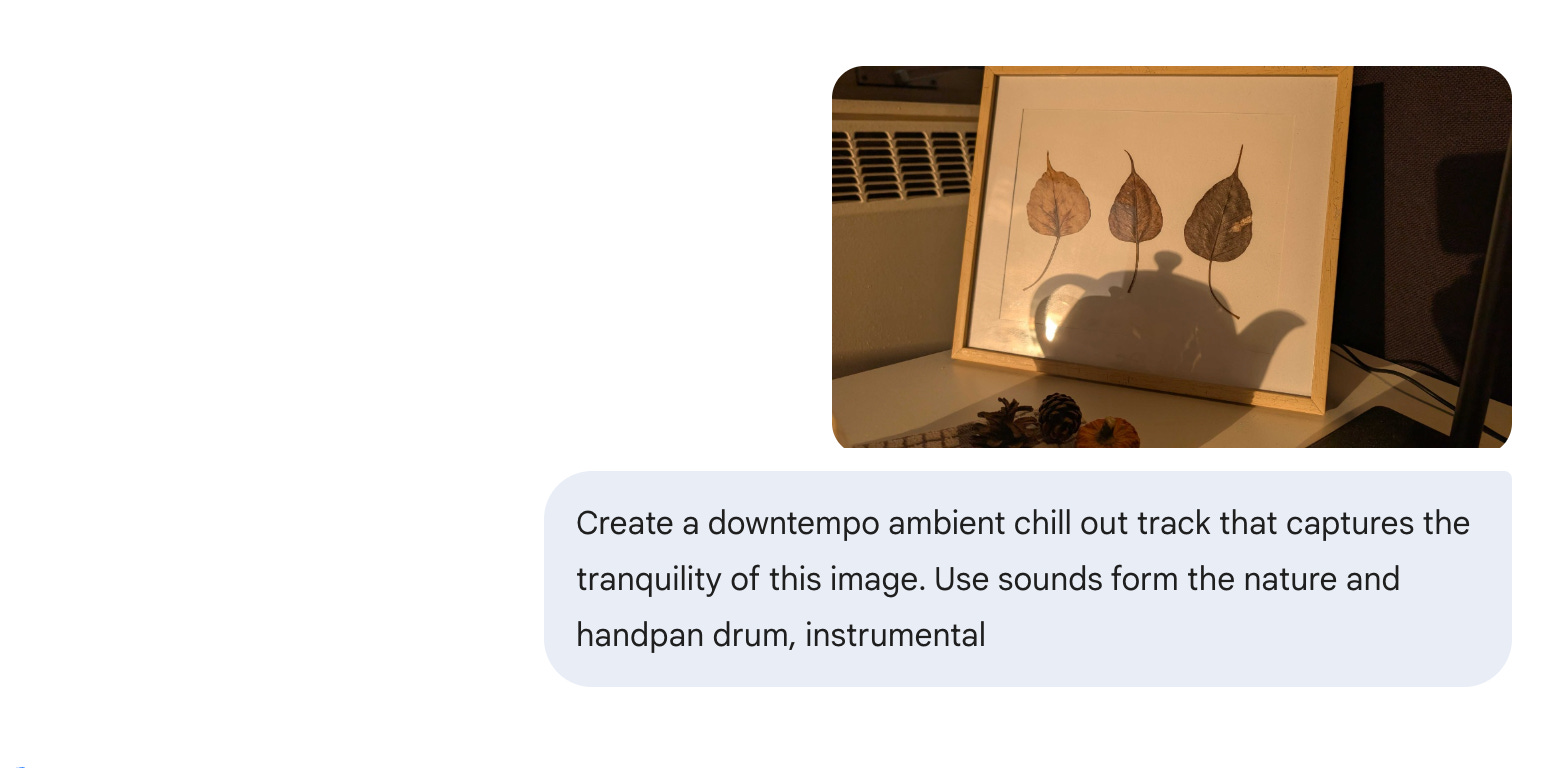
Upload a photo - holiday snaps, your pet, a piece of art, a sunset and Lyria analyses the subjects, setting, colours, and mood to compose a matching track.
Template:
[Upload image] Create a [genre] track that captures the [mood/feeling] of this image. [Instrument and vocal preferences].
Example:
[Upload photo] Create a downtempo ambient chill out track that captures the tranquility of this image. Use sounds form the nature and handpan drum, instrumental
10 Prompts You Can Try in Gemini Today
Copy and paste any of these directly into the Gemini app:
1. The Personalised Birthday Song Create a joyful, upbeat birthday pop song with catchy melody, hand claps, and cheerful brass. Male vocals, fun and goofy. Lyrics should be celebratory and humorous about getting older but still feeling young.
2. The Focus Soundtrack A calm lo-fi hip hop beat with warm dusty piano, soft boom-bap drums, and a lazy saxophone melody. Slow tempo, relaxed and cozy. No vocals.
3. The Podcast Intro A confident, modern electronic track with a punchy beat, bright synth hook, and crisp production. 10 seconds of build into a catchy drop. Fast, energetic, professional.
4. The Nostalgic Throwback An early 2000s pop-punk track with driving electric guitar, fast drums, and anthemic energy. Male vocals, raw and passionate. A song about missing your hometown.
5. The Cinematic Moment A cinematic orchestral piece with soaring strings, powerful brass, and thunderous percussion building to an epic crescendo. Heroic, triumphant, and grand. Film score quality.
6. The Cross-Cultural Fusion A track combining Japanese koto with modern electronic production, tabla percussion, and ambient synth textures. Ethereal, meditative mood with unexpected rhythmic complexity.
7. The Workout Banger High-energy EDM track with massive bass drops, pulsing synths, aggressive drums, and a huge build-up. 130 BPM, relentless energy. No vocals.
8. The Bedtime Lullaby A gentle, soothing acoustic lullaby with soft fingerpicked guitar, warm cello, and a tender female vocal. Very slow tempo, peaceful and dreamy. Lyrics about stars and sweet dreams.
9. The Afrobeat Party High-energy Afrobeat track with driving percussion, funky guitar rhythms, bright brass hits, and a groovy bass line. Male and female duet vocals with playful lyrics about dancing all night. 110 BPM.
10. The Genre Experiment A track that fuses baroque classical harpsichord with drum and bass electronic production. Fast tempo, complex rhythms, dramatic dynamics. Start with solo harpsichord, then drop the bass.
Download the Full Prompting Guide
For a deeper dive - including the complete reference tables of 70+ supported genres, 80+ confirmed instruments, mood descriptors, vocal options, advanced techniques, API-specific prompting, and Lyria RealTime configuration - download our comprehensive Lyria Prompting Guide:

Download Lyria Complete Prompting Guide
Frequently Asked Questions
Is Lyria 3 free to use? Yes. Lyria 3 is available to all Gemini users aged 18+ globally. Google AI Plus, Pro, and Ultra subscribers get higher generation limits, but the base experience is free.
Can I use Lyria-generated music commercially? Usage rights are governed by Google’s Terms of Service for the Gemini app. All generated tracks carry a SynthID watermark. For specific commercial licensing questions, consult Google’s official terms.
Can Lyria copy a specific artist’s style? Not directly. If you include an artist’s name in a prompt, Lyria treats it as broad creative inspiration - generating something with a similar mood or style, not an imitation. Filters are in place to check outputs against existing copyrighted content.
What’s the maximum track length? Currently 30 seconds per generation in Lyria 3 (Gemini app) and about 32.8 seconds per clip in Lyria 2 (Vertex AI API). Lyria RealTime streams continuously but sessions are capped to approximate 10 minutes.
Does Lyria only generate music in English? No. Lyria 3 (Gemini app) supports vocals and lyrics in eight languages: English, German, Spanish, French, Hindi, Japanese, Korean, and Portuguese. More languages are planned. Lyria 2 (Vertex AI API) currently accepts prompts in US English and generates instrumental‑only music.
Can I upload my own lyrics? Yes. Prefix your lyrics with Lyrics: in the prompt. Use parentheses for backing vocals or echoes, for example: Lyrics: We rise up (rise up) into the light (the light).
Is there an API for developers? Yes - Lyria 2 is available via Google Cloud’s Vertex AI, and Lyria RealTime is accessible through the Gemini API. Both require API keys and are geared toward developer and production workflows.
Final Words: Where AI Music Is Heading
What makes Lyria 3 significant isn’t just the technology - it’s the timing. We’re entering a period where AI-generated audio, whether music, voice, or soundscapes, will become one of the dominant modes of content consumption. Audio is effortless to digest. You can consume it on the go, during a commute, while cooking. Unlike text or video, it doesn’t compete for your visual attention. As AI makes audio creation instantaneous and near-costless, the sheer volume of AI-generated audio content will explode.
For music specifically, I expect a pattern of boom followed by selective correction. The initial excitement is justified - from a pure business perspective, AI music generation is a clear win. It streamlines creative production, compresses timelines, and dramatically reduces costs. For content creators, advertisers, game developers, and anyone who needs original music at scale, tools like Lyria fundamentally change the economics. Background music for videos, podcast intros, social content, in-store ambience, hold music - the commercial use cases are enormous and the ROI is immediate.
But here’s the nuance that most commentary misses: the very quality of AI music creates its own challenge. Right now, everything sounds equally polished. There’s a normalisation effect - the output is consistently good, but consistently predictable. There are no happy accidents, no rough edges, no moments where a musician’s imperfection becomes the thing that makes a track unforgettable. That absence of surprise will eventually become noticeable.
This is why I believe we’ll see the emergence of distinct audience segments. There will be a new, legitimate category of AI-generated music with its own dedicated audience - people who appreciate the standard, sounding good music with the accessibility, and the personalisation that AI enables. There will also be a counter-movement: a revival of appreciation for 100% human-created music, similar to how vinyl and analogue recording saw a resurgence in the streaming era. Both audiences will coexist, and both markets will thrive.
The smartest artists are already ahead of this curve. Musicians like will.i.am and Dr. Dre have integrated AI into their creative workflows - not as a replacement for human creativity, but as an amplifier of it. These are artists with proven track records of success, and their embrace of AI isn’t a concession. It’s a competitive advantage. They use AI to generate ideas faster, explore sonic territories they might not have considered, and handle the mechanical aspects of production so they can focus on the creative decisions that actually matter. The result is music that has both the efficiency of AI and the soul of human intent.
That, ultimately, is the most likely future: not AI versus human music, but AI as a creative instrument - one that the most adaptable artists and businesses will wield to produce work that neither could achieve alone.
Lyria 3 is one of the earliest mainstream tools that makes this future tangible for everyone. Whether you use it for a birthday song, a brand soundtrack, or the starting point of your next creative project - the barrier to musical creation just dropped to zero.
The question isn’t whether AI music will be part of your world. It’s whether you’ll be the one creating it, or just consuming it.