


Anthropic released Claude Opus 5.5 on September 22nd. It’s their new flagship model, and the headline is unusual: it costs 40% less to run than the previous Opus, while scoring higher on nearly every benchmark Anthropic published. That combination doesn’t happen often. Usually a cheaper model means a weaker one.
Here’s what actually changed, how it stacks up against GPT-6 Astra and Gemini, and five ways I’d apply it in marketing.
TL;DR
Claude Opus 5.5 launched September 22, 2026, Anthropic’s newest flagship model, and its first release since CEO Dario Amodei called for “pacing” AI progress
It performs close to Anthropic’s top-tier model on most tasks, at 40% less cost to run
Pricing dropped to $4 per million input tokens and $20 per million output, cache reads down 60% to $0.20
It writes shorter, clearer answers than earlier Claude models. Leads with the point instead of burying it
Live now in Claude.ai, Claude Code, Claude Cowork, the API, and on AWS, Google Cloud, and Azure
No image generation. Text and images go in, text comes out
Five practical marketing applications below, most grounded in Anthropic’s own testing, not just my speculation
What actually changed?
Three things, and only one of them is about raw intelligence.
Performance. On Anthropic’s own agentic coding test, Opus 5.5 scored 66.4%, up from 52.3% for the previous Opus. One early tester ran an 18-hour unattended session across six code repositories and reported almost no rework needed afterward. I take vendor numbers with a grain of salt, always, but the direction holds across a dozen independent companies quoted in the release, not just Anthropic’s own lab. Deloitte said it caught 72% of known bugs at its lowest setting, where the previous model caught 56% even set to maximum effort.
Cost. Input tokens are $4 per million, output $20, both down 20%. Cache reads, which make up most of the bill in agent workflows, dropped 60% to $0.20. Combined, Anthropic claims a 40% lower cost for a typical task. Think of it the way SEO changed the economics of getting found online in the late 90s. Same outcome, suddenly a fraction of the cost to achieve it.
Communication. This is the one leaders will actually notice day to day. It writes shorter answers, leads with the conclusion, skips the throat-clearing. Box reported 40% less verbose output with no drop in accuracy. Reads like a colleague who respects your time, not a report padding itself out to look thorough. Small thing on paper. Compounds fast across every summary your team reads this quarter.
How does it compare?
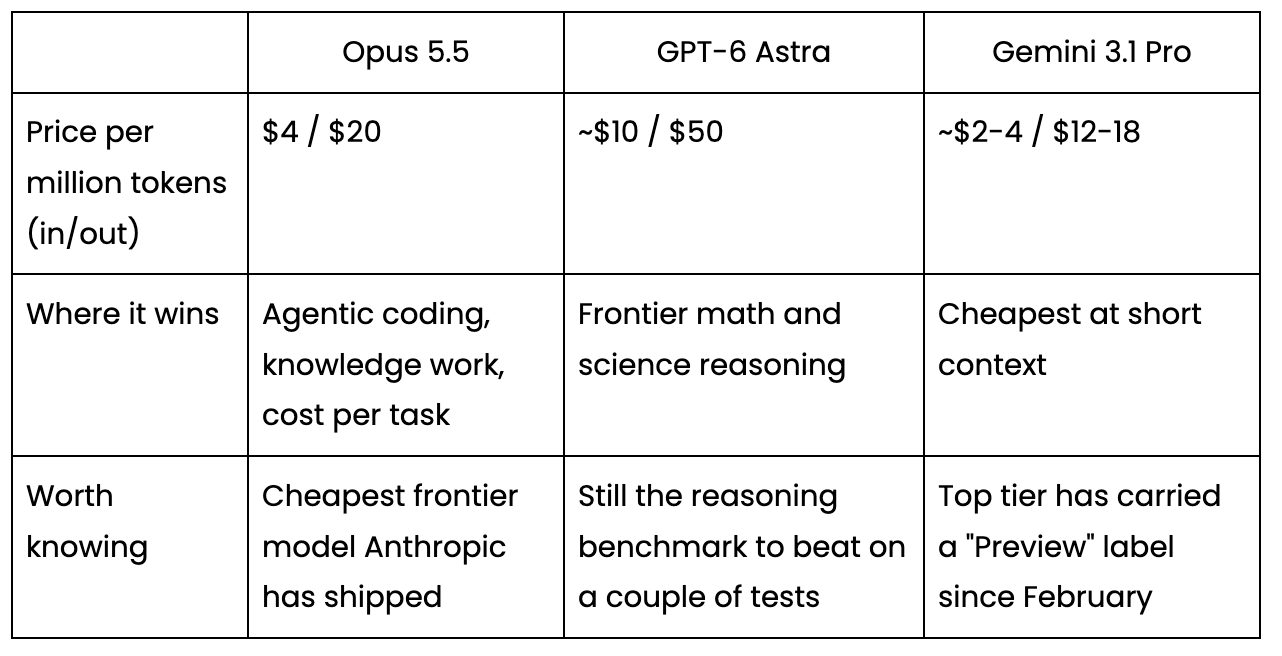
It depends what you’re optimising for. If cost per finished task is the question, Opus 5.5 is currently the strongest published answer on the market. If you need the absolute ceiling on frontier reasoning, Astra keeps an edge on two shared benchmarks, one of them by a real margin. Neither gap is large enough to build a whole strategy around, probably.
What’s actually been proven so far
Worth separating what Anthropic tested from what I’m extrapolating below. None of these are marketing examples, they’re from coding and finance, but they’re real, attributed, and independently confirmed:
A 680,000-line code migration, done in under a day. Work Anthropic says would normally take an engineering team weeks.
Fixed load-time issues across 39 of 40 pages of a web app, without breaking anything, where the previous model’s fixes changed how the app behaved along the way.
Caught a mistake in its own instructions. Investment firm Walleye Capital gave it an evaluation task. At a higher effort setting, it noticed the firm’s own test had an indexing error and corrected for it. No model they’d tested before had caught that.
Fixed a bug overnight with no supervision. Trading firm Chicago Trading Company had it diagnose and fix a bug in their systems unattended. By morning, the fix was done and had passed their test suite.
Rewrote old software into a modern language. Anthropic had it translate HAProxy, widely-used traffic-balancing software, from C into Rust. It passed nearly all of the original tests, finishing faster and cheaper than Anthropic’s own top-tier model doing the same job.
5 marketing use cases worth exploring
Here are 5 ideas for marketing use, untested, just my own thinking on where this could go.
1. Self-checking campaign content. Set up a two-step pipeline: draft, then have the model review its own draft for unsupported claims, invented stats, or shaky quotes before it reaches a client or goes live. Checking its own reasoning is part of how Opus 5.5 works by default, so it catches weak claims in the same pass instead of needing a second model or a human to catch them first.
2. Brand-grounded drafting at scale. Load your brand guidelines, tone-of-voice document, and a year of past campaigns into one session, then draft from that instead of a blank prompt. The 1 million token context window is what makes this possible. It holds all of that material at once instead of you summarising or trimming it to fit, so the draft reflects your actual voice rather than a generic one.
3. Competitive research that doesn’t stop at the first answer. Point it at a stack of competitor pages, pricing pages, and recent campaigns, and ask what’s changed and what it means, not just for a summary. Opus 5.5 is built to keep reasoning through a problem instead of stopping at the first plausible explanation, so it’s less likely to hand back a shallow “nothing’s changed” when something actually has.
4. Reports and decks nobody wants to build by hand. Drop in your raw ad platform exports, screenshots, CSVs, charts, and ask for a workbook and a one-page deck, not a written summary. Chart and screenshot reading improved meaningfully in this release, so it can parse messy visual exports directly instead of only working from data you’ve already cleaned up.
5. Personalisation without the personalisation tax. Write the core message once at the model’s highest effort setting, then generate the long tail of segment variants at a lower, cheaper setting. Effort is adjustable per request, from quick and cheap to slow and thorough, so you’re not paying flagship rates for every one of a hundred variants, only for the one that matters most.
AI does the heavy lifting here. Humans still own the judgement call on what to do with what it finds.
FAQ
What is Claude Opus 5.5?
Claude Opus 5.5 is Anthropic’s flagship AI model, released September 22, 2026. It leads in agentic coding and knowledge work while costing 40% less to run than its predecessor, Claude Opus 5.
How much does Claude Opus 5.5 cost?
$4 per million input tokens and $20 per million output tokens through the API, down 20% from Opus 5. Cache reads cost $0.20 per million tokens, a 60% cut.
Can Claude Opus 5.5 generate images or ad creative?
No. It reads and analyses images but does not generate them. It’s a text-and-image-in, text-out model, so image and video creative still need a separate tool.
How does Claude Opus 5.5 compare to GPT-6 Astra and Gemini 3.1 Pro?
Opus 5.5 is cheaper than both and leads on most coding and knowledge-work benchmarks. Astra costs more and edges ahead on a couple of specialised agentic benchmarks. Gemini’s top tier remains labelled “Preview” seven months after its own launch.
Is Claude Opus 5.5 useful for marketing teams specifically?
Yes, particularly for content QA, brand-grounded drafting, competitive research, reporting, and personalisation at scale. It has no marketing-specific mode. The value comes from applying a stronger general model to marketing workflows.
Final Thoughts
Every model release comes with a press page full of superlatives, and I’ve learned to read past most of it. What stood out here wasn’t the benchmark chart. It was the communication example buried halfway down the release notes: the same bug explained in half the words, the important line first.
Keep it simple. Turns out that’s not just a tagline anymore. It’s a model feature.