


A customer asks ChatGPT for a recommendation and your business comes up. What it says about you comes from whatever it has found, and until now you could not manage that directly. On November 10, OpenAI launched Businesses in ChatGPT, a beta that lets you claim your business, keep your information up to date and see how often you are mentioned. With 1.2 billion weekly users, according to OpenAI, I think AI is becoming the new discovery channel for business and for sales.
TL;DR
Business Hub (beta, launched November 10) lets you claim your business in ChatGPT, manage your information and see mentions, website clicks and topics.
Setup is 10 short steps. You need access to your domain settings, a phone and a government ID.
Business Agents, a labelled chat that answers customer questions, are US only for now.
Claiming does not guarantee higher placement or more sales. OpenAI says so itself.
My seven predictions: cleaner data, a new space to compete, new metrics, the agent as the front desk, an ads and agents ecosystem, profiles across several AI platforms, and a website that becomes a database.
This week: claim, prepare your facts, start tracking, explore, stay on top of it.
What is ChatGPT Business Hub?
OpenAI says 1.2 billion people use ChatGPT each week. Business Hub is where your business shows up there on your own terms. You can do three things in it. First, claim your business and keep your information up to date. Second, see insights: how often ChatGPT mentions you, how many people click through to your website, and the topics behind those mentions. The data is aggregated, so you never see the conversations. Third, build a Business Agent, a labelled chat inside ChatGPT that answers customer questions from the information you give it. The agent is US only for now, for ecommerce and online services, and you can sponsor it with ChatGPT Ads.
The Hub itself is open to eligible businesses wherever ChatGPT is available.
How do you set up your profile?
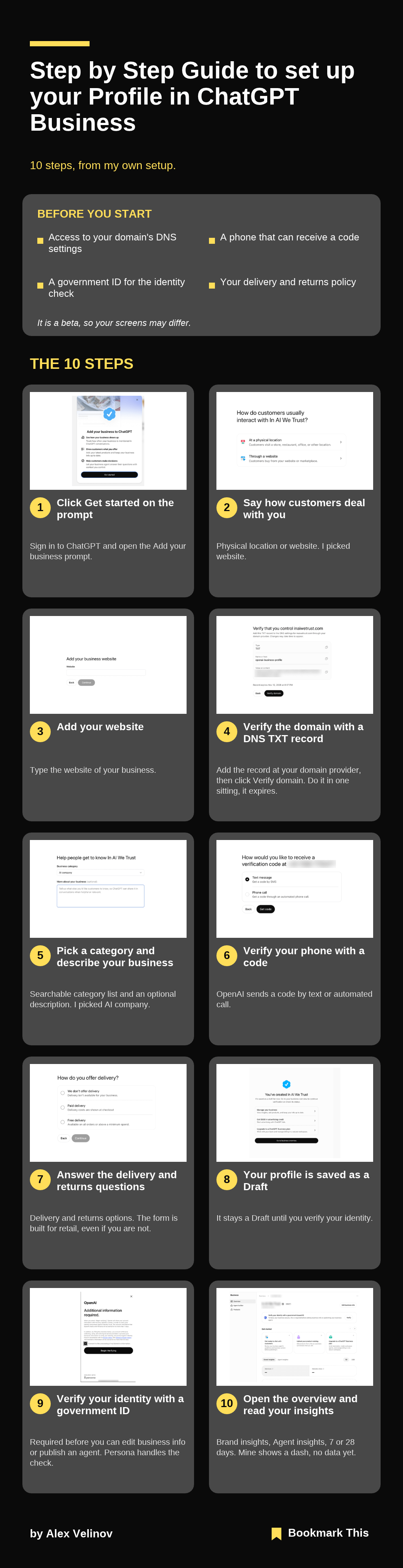
It is a beta, so your screens may differ. Before you start, have ready: access to your domain’s DNS settings, a phone that can receive a code, a government ID, and your delivery and returns policy.
Open the “Add your business to ChatGPT” prompt and click Get started.
Say how customers deal with you: at a physical location, or through a website.
Add your website.
Verify the domain with a DNS TXT record from your domain provider.
Pick a category, add a short description and your contact details.
Verify your phone with a code.
Answer the delivery and returns questions.
Your profile is saved as a Draft.
Verify your identity with a government ID. It is required before you can edit business info or publish an agent.
Open the overview: Brand insights, Agent insights, 7 or 28 days. Mine shows a dash for now, because there is no data yet.
Seven predictions: where this is heading
Prediction 1: Clean data becomes the advantage
ChatGPT now has a new way to collect data: verified, and coming straight from the business. In exchange, it gives data back. I think over time this makes what ChatGPT says about a business more accurate, and more trustworthy on plain facts like prices and policies. The model does the heavy lifting, the business provides the context. The brand with the same name, offer and policies everywhere starts ahead.
Prediction 2: A new space to compete
Marketing just got a new platform to explore, and brands will get more competitive there. History repeats itself. SEO did not exist before search engines, and Google is under 30 years old. I assume new forms of listing and optimisation will appear over time, and new businesses will be built around them.
Prediction 3: New metrics, and an obsession with them
Mentions, clicks and topics are the early shape. I think the numbers that matter will move towards authority and brand reputation, not only traffic. Brands will get obsessed with them, the same way they did with rankings. Then come the optimisations for those metrics.
Prediction 4: The agent is the new front desk
This is the one I like the most. Imagine your customer support living inside ChatGPT. The customer talks to your brand where they already are, and the Business Agent answers from the information you control. I believe this opens a completely new channel to manage, optimise and report on, like a new tool in your tech and marketing stack.
Prediction 5: Ads and agents become an ecosystem
You can already sponsor your agent as the destination for ChatGPT Ads, and the last screen of my setup offered $500 in advertising credit. Profiles, agents and ads together look to me like the beginning of a full ecosystem across the large language models. I think ChatGPT leads this right now, based on everything already on the platform.
Prediction 6: Brands will manage several AI profiles
I expect other platforms to follow. Gemini, Claude and ChatGPT are a good start, Perplexity probably, who knows who else. At some point a brand will need a listing, clean data and an agent in each of them, the way it manages Google, social and review sites today.
Prediction 7: Your website becomes a database
This is the boldest one, and I might be early. If search and discovery shift into the large language models, a website is needed less as a place people visit. I think it ends up as the store of your unique, accurate data. Maybe not even the transaction layer, because the sale could happen directly inside the model. Today OpenAI says nothing like this. Business Hub even counts clicks to your website, and agents are US only. But I would rather be in the driving seat than be surprised.
What should you do this week?
Claim and verify. Register your business and complete the verification.
Prepare your facts. One description, one set of policies, the same on your website and everywhere else.
Start tracking. Write down your baseline, then watch mentions, clicks and topics.
Explore. Get familiar with the Hub and the options, including the agent builder where it is available to you.
Stay on top of it. It is a beta and it will change. Check back every month.
FAQ
What is ChatGPT Business Hub? OpenAI’s beta for claiming your business in ChatGPT, managing your information and seeing aggregated insights.
Do I need to be in the US? Not for the Hub, if your business is eligible and ChatGPT is available where you are. Business Agents are US only for now.
Does claiming improve my visibility? Not by itself, according to OpenAI. It lets you manage your information and see data.
Can I see what people asked ChatGPT? No. You see aggregated mentions, clicks and topics, not conversations.
Final Thoughts
I don’t know how fast any of this moves. What I see is the same pattern as Google 20 years ago: a new place where customers look, a profile to claim, and numbers to read. My seven bets are cleaner data, a new space to compete, new metrics, the agent as your front desk, an ecosystem of ads and agents, profiles across several models, and a website that does less of the work.
Claim your profile this week. Then check back in a month.