



TL;DR
Why does LinkedIn matter for LLM visibility now? It is the #2 most cited domain overall across major AI platforms - and the #1 most cited source specifically for professional queries across ChatGPT, Gemini, Google AI Overviews, Copilot, and Perplexity (Profound, 2026). When someone asks an AI a business question, LinkedIn is almost always in the answer.
What kind of content actually gets cited? Original, educational posts and articles. Reshares rarely appear. Most cited posts have moderate engagement - around 15 to 25 reactions. Posts with 10+ quality comments carry strong credibility signals with AI systems.
Do follower count and posting frequency matter? Yes to both. Accounts with 3,000+ followers carry more authority signals. About 75% of cited authors post 5 or more times per month. Consistency beats virality, every time.
Is paid content worth it for AI visibility? More than most people realise. Boosted posts are 41% more likely to be cited by AI than organic posts. Thought Leader Ads outperform standard boosts by another 28%.
What is the fastest way to start? Publish a well-structured article (800-1,200 words) on a topic you genuinely know. Then post consistently and engage meaningfully in the comments.
Positioning in LLMs in 2026 is like positioning in Google in 2010
In 2010, if you told a marketing director to “think about Google,” they probably nodded along. Everyone understood SEO in principle. But most businesses had no real strategy for it. The ones that built one early - they are still ahead today. Fifteen years later, the gap between those who showed up early and those who waited is enormous.
I think we are in the same moment right now, but for large language models.
When someone asks ChatGPT, Perplexity, or Google AI Mode a professional question - “who are the best event marketing agencies,” “what does a modern AI strategy look like,” “how should we approach B2B lead generation” - the AI pulls its answer from somewhere. That somewhere has a hierarchy. For consumer queries, Reddit is widely cited as a dominant source in AI search. For B2B and professional queries, LinkedIn is at the top, by some distance.
The reason is not complicated. Reddit works for AI because it is the internet’s largest source of human opinion at scale. But when an LLM is answering a business question, it looks for credibility signals. Industry expertise. Professional authority. Named individuals with real credentials. LinkedIn is the only platform that provides all of that in a structured, crawlable format. It has become, according to Profound’s 2026 analysis, the #1 most cited source for professional queries across every leading AI platform.
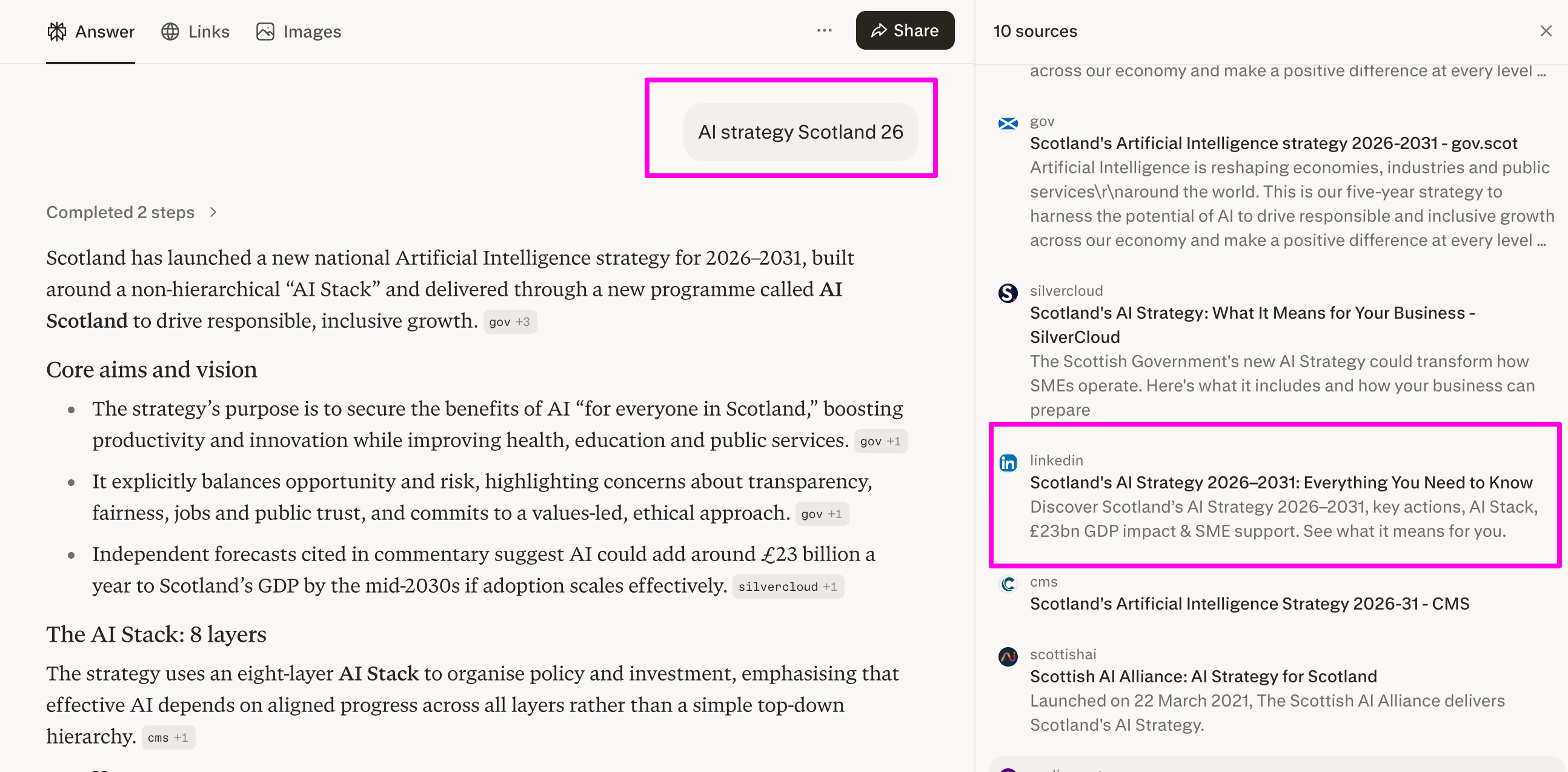
I found this out in a very practical way. Earlier this year I published a LinkedIn article shortly after attending the launch event for Scotland’s AI Strategy 2026-2031. It was not a long piece - just a clear summary of the strategy, written in plain language so anyone could understand what was announced and what it actually means in practice. Within days, that article was appearing as a cited source in LLM responses about Scottish AI policy. That is when I stopped treating this as a theory.
The numbers behind the shift
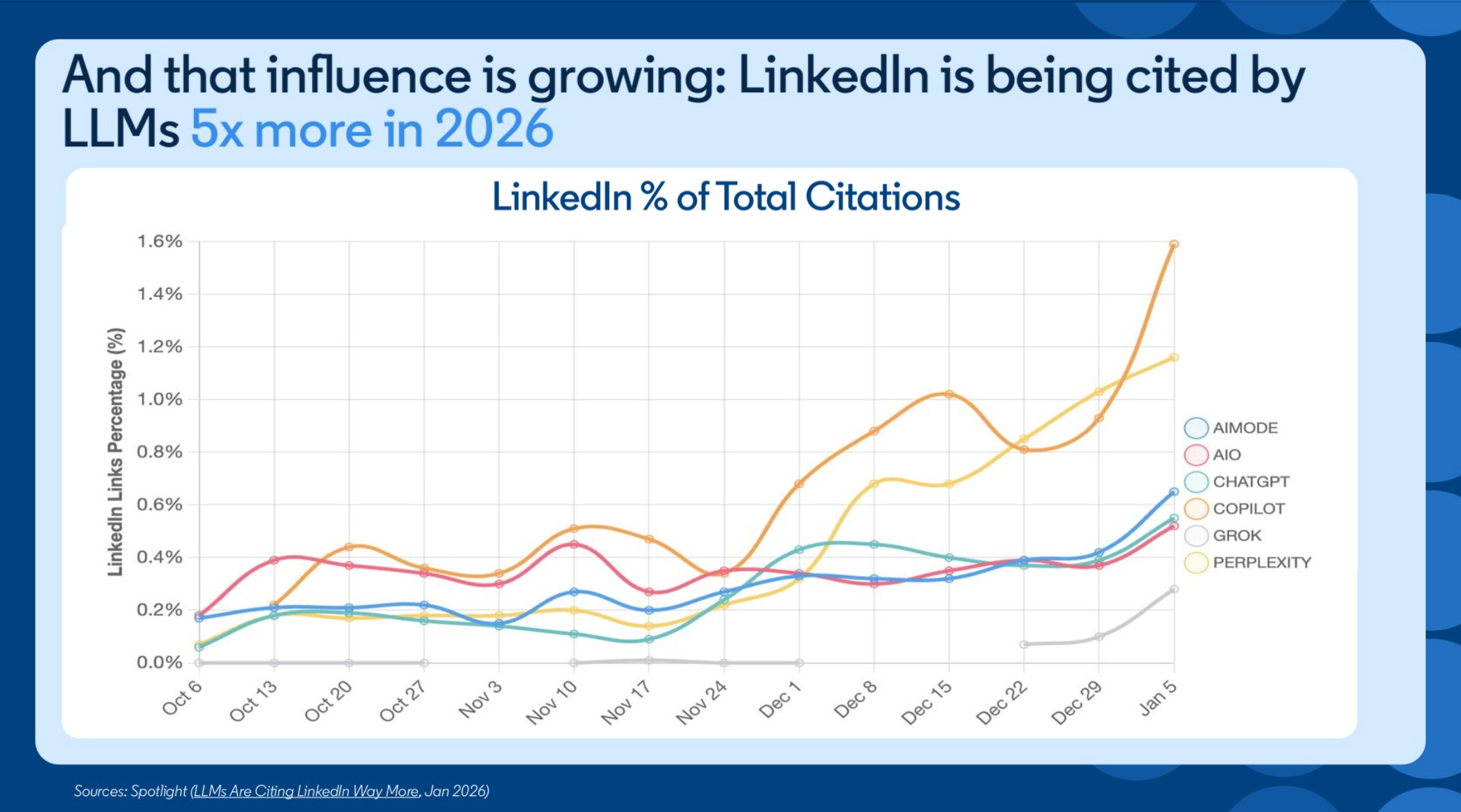
Before we get into what to do, here is where we are. These numbers are from three separate research sources published between October 2025 and March 2026.
LinkedIn is the #2 most cited domain overall across AI search platforms, appearing in 11% of AI responses on average (Semrush, analysis of 89,000 LinkedIn URLs)
For professional queries specifically, LinkedIn ranks #1 most cited source across ChatGPT, Gemini, Google AI Overviews, Microsoft Copilot, and Perplexity - ahead of every major news publisher and professional platform (Profound, 2026, 1.4 million citations, November 2025 - February 2026)
LinkedIn’s ChatGPT citation rank went from #11 in November 2025 to #5 by February 2026 - a doubling in under three months
LLM citations of LinkedIn grew 5x in 2026 overall
Traffic to LinkedIn from AI search increased 40% in just three months (LinkedIn internal data, February 2026)
Combined posts and articles now account for 35% of all LinkedIn citations in ChatGPT responses, up from 27% three months earlier
The trend is accelerating. Most brands have not adjusted yet. That gap is your opportunity - but it will not stay open forever.
5 LinkedIn Strategies That Build LLM Visibility
1. LinkedIn Posts - Short Form, but Substance First
A LinkedIn post can be as short as 50 words. The cited range is 50 to 299 words. That is not a lot. But it turns out that is plenty for an LLM to pick up, if the content is right.
The Semrush analysis found that 54-64% of cited posts focus on sharing knowledge or practical advice. The posts that get ignored? Reshares. Motivational quotes. Thinly-veiled promotions. LLMs are looking for original perspective and useful information - the same things human readers look for, actually.
The engagement signal matters here too. Independent research across 89,000 cited LinkedIn URLs found that most cited posts have moderate engagement - around 15 to 25 reactions. That said, LinkedIn’s own platform data suggests highly cited content typically reaches 60+ reactions. The practical takeaway: you do not need a viral post. Consistent, modest engagement over time is what registers. Posts with 10+ quality comments are also increasingly influential - and when I say quality comments, I mean substantive ones - replies that add perspective, debate the point, or share a related experience. “Great post!” does not move the needle for AI credibility. A comment that says “we tested this and saw different results in our market” does. Encourage that kind of dialogue. Ask questions at the end of your posts. Respond when people engage.
2. LinkedIn Articles and Newsletters - Long Form for Authority
If posts are the signal, articles are the authority layer. LinkedIn’s own data shows that articles 800-1,200 words are the strongest lever for AI visibility. The Profound data confirms it - long-form content on LinkedIn grew its share of AI citations by nearly 50% between November 2025 and February 2026, going from 6% to almost 9%.
Why does long form work better for LLMs? Because it demonstrates depth. A 1,000-word article on a specific professional topic shows that someone knows what they are talking about, in a way that a 200-word post cannot. AI systems are essentially doing a credibility check every time they decide whether to cite a source. Long-form content passes that check more consistently.
Newsletters are a close relative of articles here. Publishing regularly - even monthly - compounds the authority signal over time. The key is consistent topic focus. A newsletter about events industry AI trends will accumulate more LLM authority than one that jumps between subjects every edition.
3. LinkedIn Company Page - Your Brand’s Source of Truth for AI
LLMs treat Company Pages as structured reference material. When an AI is asked who a company is, what they do, or which industry they serve, it often pulls that answer directly from the Company Page. LinkedIn’s internal data suggests LLMs prioritise fields like company descriptions, products, leadership, industries, and job titles.
This means those fields need to be written in plain, specific, natural language - not brand-speak. “We help B2B companies grow revenue through strategic event marketing” is better than “We are a full-service integrated marketing solutions provider.” Write it the way you would explain it to someone at a dinner party, not the way it reads on a legacy about page.
Update the page regularly. Add posts from the page itself. Keep it active. A dormant Company Page sends a weak signal to both humans and AI.
4. Employees, Executives, and Influencers - Human Voices Carry More Weight
This is probably the most counterintuitive finding in the data. Perplexity cites Company Pages for 59% of LinkedIn references, but ChatGPT and Google AI Mode flip that - they more often cite individual creators (also 59%). The takeaway is that both matter, but individual voices, especially credible ones, are increasingly influential.
The credibility threshold data points to 3,000+ followers as a meaningful baseline. That is not the ceiling - it is the floor where authority signals start to register consistently. Executives and subject matter experts who post regularly on their own profiles, engage in substantive debate, and share genuine perspective - not corporate talking points - are becoming one of the most powerful assets a company can activate for AI visibility.
Partnering with credible industry influencers follows the same logic. Authentic engagement from a respected voice in your category is worth far more than a dozen polished posts from a brand account.
5. Thought Leader Ads - Amplify What is Already Working
Here is where most brands stop too early. They publish good content, see some engagement, and move on. But paid amplification at this moment is disproportionately valuable.
Boosted posts on LinkedIn are 41% more likely to be cited by AI than equivalent organic posts. Thought Leader Ads - which promote content from individual accounts rather than company pages - outperform standard page boosts by an additional 28%. That is a significant edge.
The right way to use this: identify posts and articles that are already generating quality engagement, then amplify them. Do not use paid to prop up weak content. Use it to extend the reach of content that is already resonating, because that reach compounds the engagement signals that AI systems notice.
Bonus: Combine Everything for Compounding Impact
The real advantage comes when these five strategies work together as a system. Publish a short-form post to test an idea. If it generates genuine discussion, expand it into an article. Promote the article through Thought Leader Ads. Have executives share their own perspective in the comments. Let the Company Page reflect the same themes.
Consistency is the multiplier here. The Semrush data found that about 75% of cited authors post 5 or more times per month. Not because volume alone drives visibility - but because frequent, relevant posting builds the kind of sustained presence that AI systems recognise as authoritative over time. One great article is a signal. Twelve great articles over twelve months is a pattern. Patterns get cited.
What makes LinkedIn content visible to LLMs - the short version
If you want a checklist, here it is:
Content type: Original posts and articles. No reshares.
Post length: 50-299 words for posts. 800-1,200 for articles.
Engagement: 10+ substantive comments. 15-25 reactions is the typical cited range; highly cited content reaches 60+. Replies that add perspective, not just praise.
Posting frequency: 5+ posts per month minimum.
Follower count: 3,000+ as a baseline for authority signals.
Company Page: Complete, specific, written in natural language. Updated regularly.
Individual voices: Executives and subject matter experts posting authentically outperform brand accounts.
Paid amplification: Boost top-performing content. Prioritise Thought Leader Ads over standard page boosts.
Topic consistency: Stay focused. LLMs recognise topical authority over time.
Final Words
LinkedIn has always been the most credible professional network. That credibility is now doing something new - it is becoming the default reference layer for AI-driven B2B discovery.
The Google 2010 analogy I started with is probably generous. The window for building an early-mover advantage in LLM visibility on LinkedIn may be shorter than the early SEO window was. Both LinkedIn and LLMs are moving fast, and the rules will keep changing.
Start with the strategies above. Post consistently. Track what gets cited. Adjust as you learn. The brands that build this muscle now will be the ones AI recommends next year - and the year after that.