



TLDR
Most organisations are using AI but thinking exactly the same way they always have. An AI-First Mindset is not about tools. It is about rewiring how you approach every problem, challenge every assumption, and question every workflow that has existed in your business since before ChatGPT was a thing. This article covers what it means, the two questions that change everything, six core principles, seven practical actions you can take this week, and answers to the most common questions leaders ask when they first encounter this idea.
The phrase that is quietly killing your business
There is a phrase you have probably heard in your organisation. Possibly said yourself. It goes something like this:
“That’s how we do it here.”
Sometimes it comes dressed up as process. Sometimes as policy. Sometimes it sounds perfectly reasonable. “We’ve always handled client queries within 24 hours.” Fair enough. Except when AI exists, 24 hours is a choice, not a constraint.
Here is a better question. What would we need to do to answer in one minute?
That is a completely different problem. It needs a completely different solution. And it takes a completely different way of thinking to even ask it in the first place.
This is what an AI-First Mindset actually does. It does not just make you faster at existing tasks. It makes you question whether those tasks should exist at all, and whether the standards you have built your business around still make any sense. It challenges traditional workflows, inherited processes, and the quiet assumption that because something has always worked a certain way, it should keep working that way.
It also forces a more fundamental rethink for service businesses. Growth has historically meant headcount. More clients meant more people. An AI-First Mindset challenges that relationship directly. It asks whether productivity and capacity can grow without the team growing at the same rate. That is a different kind of business model, and it starts with a different kind of thinking.
What is an AI-First Mindset?
Here is a clean definition from strategist Tim Hillegonds:
“AI First is an organizational mindset infused with curiosity, proactivity, and experimentation, aimed at embracing AI’s potential to drive innovation, elevate thinking, enhance efficiency, and unlock new opportunities for growth.”
Here is how I think about it in practice.
An AI-First Mindset is your operating system. The tools, ChatGPT, Copilot, Claude, whatever you are using, are just apps running on top of it. You can install every app in existence. If the operating system is broken, nothing works properly.
Most organisations are spending thousands on apps and nothing on the operating system.
There is a number that makes this real. According to McKinsey’s 2025 research, 88% of organisations now use AI in at least one business function. Only 7% have meaningfully scaled it across the enterprise. That gap between 88 and 7 is not a technology problem. It is a thinking problem.
Two questions that change everything
Before you start any task, any meeting, any project, any piece of work, ask yourself:
“Can I get AI to do this for me?”
If the answer is no, ask:
“Can I get AI to help me with this?”
That is it. Two questions. They sound simple. They are not.
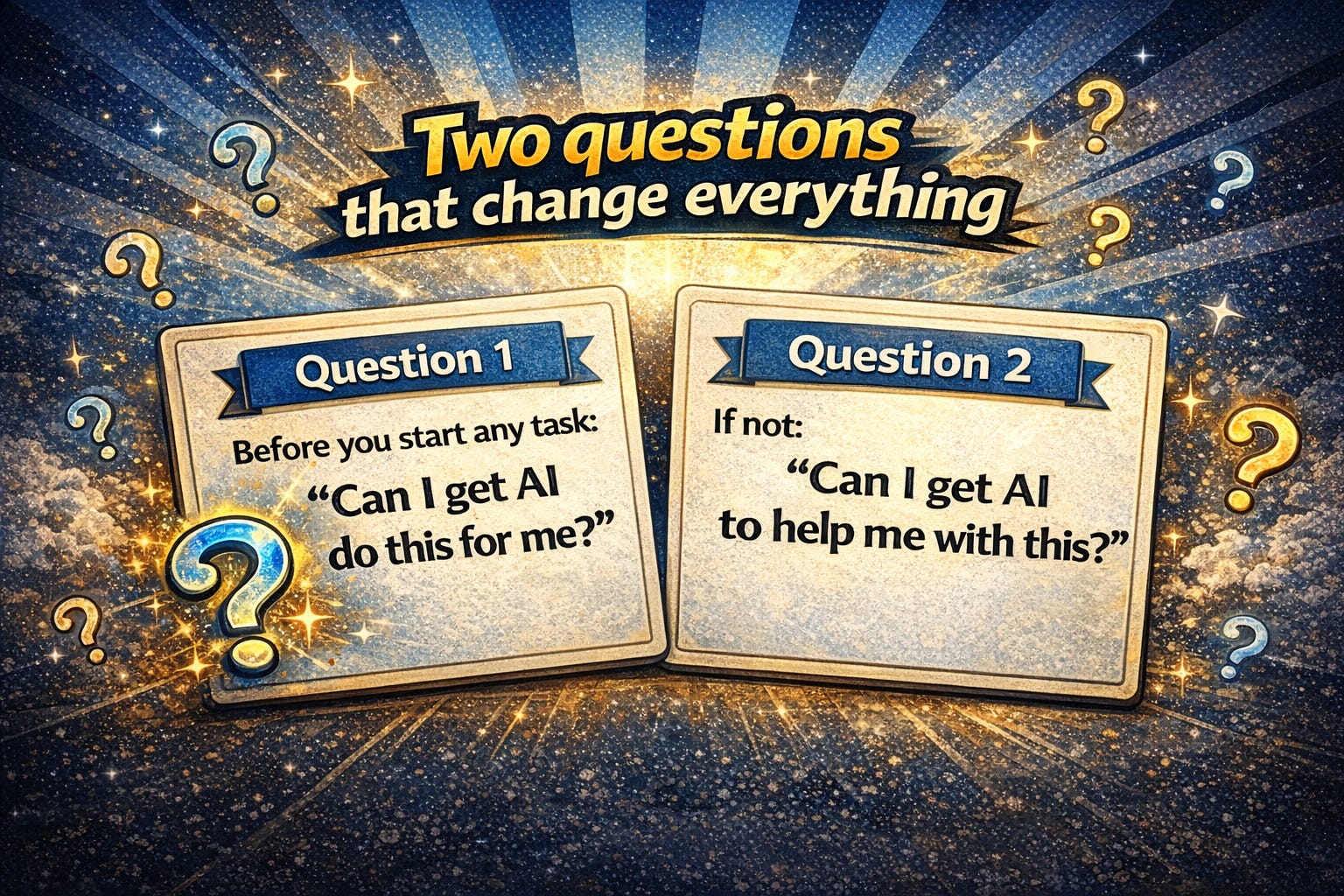
The moment those questions become automatic, the moment you ask them before you open a blank document, before you pick up the phone, before you call a team meeting, you have crossed the line. That is the AI-First Mindset in practice.
Most people never ask them. They open the document and start typing. They use AI as an afterthought, not a starting point. The mindset shift is in the order of operations. Ask first. Then act.
6 core principles
There are six principles that underpin an AI-First Mindset. They split into two groups and the distinction matters.
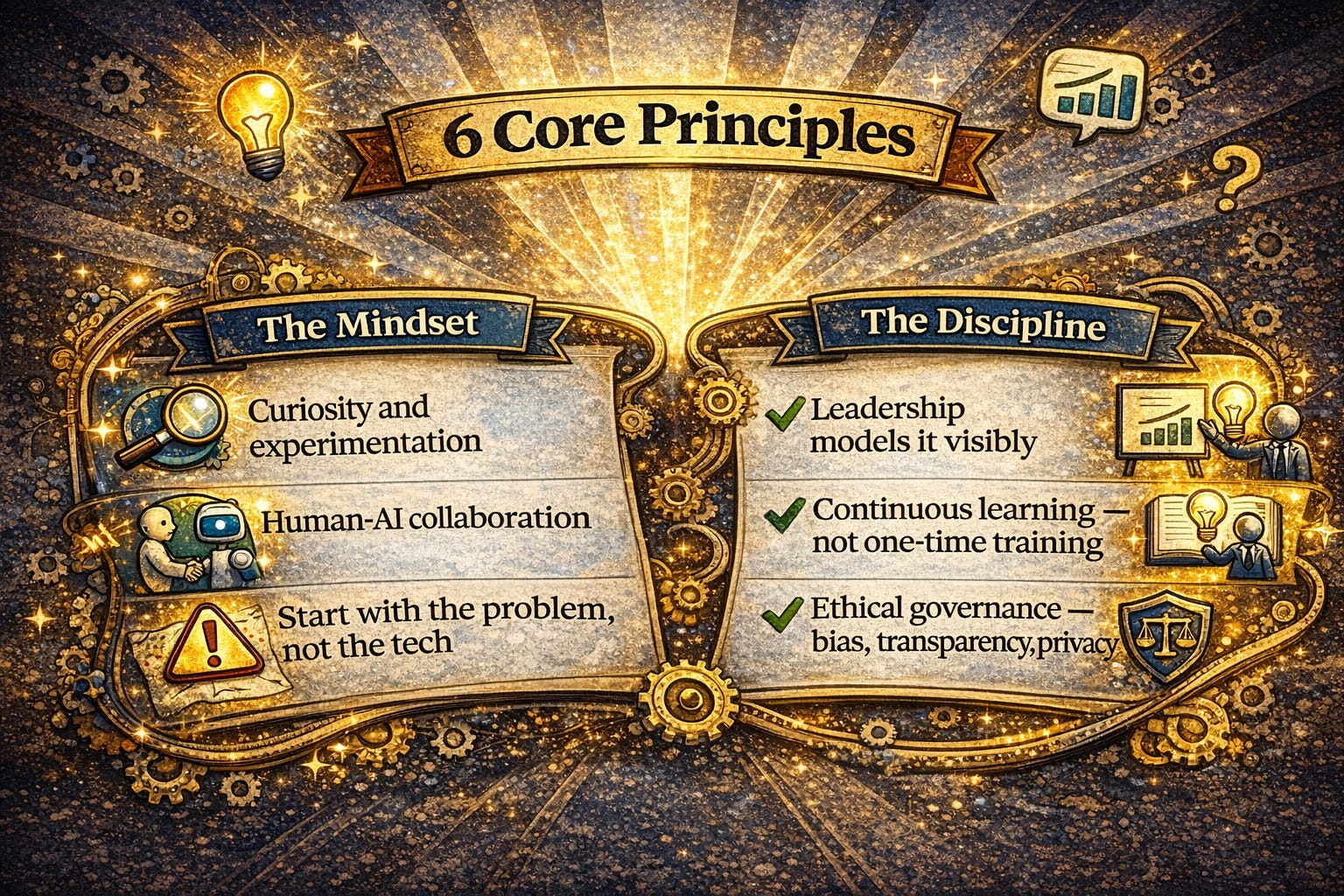
The Mindset: the cultural side
Curiosity and experimentation. This is the prerequisite. You cannot build an AI-first culture with people who are not willing to try things, break things, and learn from both. Curiosity is not a personality trait you either have or lack. It is a practice. It needs time, permission, and safety to develop.
Human-AI collaboration. Humans stay in the loop. AI handles volume. Humans handle judgment, nuance, and trust. These are not the same job and they should not be treated as interchangeable. The goal is not to remove humans. It is to elevate what humans do.
Start with the problem, not the technology. Do not ask what can we do with AI. Ask what problem are we trying to solve, then bring AI to it. This is the most counterintuitive principle and the most important one. Technology-first thinking produces solutions looking for problems. Problem-first thinking produces results.
The Discipline: the structural side
Leadership models it visibly. Not in policy documents. In daily behaviour. What leaders do, teams copy. What leaders ignore, teams deprioritise. If you use AI privately but present polished outputs publicly, your team learns nothing useful.
Continuous learning. Not a one-time workshop in January. An ongoing commitment to building capability month by month. The tools are changing fast. The people using them need to keep pace.
Ethical governance. Bias prevention, transparency, and privacy built in from the start. Not bolted on after something goes wrong. This is not a compliance box to tick. It is a foundation that makes everything else sustainable.
7 actions to embrace an AI-First Mindset
These are practical. You can start this week.
01. Go first. Visibly.
Show your team how you use AI. Share your prompts. Talk about what worked and what did not. Research from Atlassian found that a single leader demonstration nearly doubled AI usage on teams. One demo. Doubled adoption. That is the highest-leverage thing a leader can do and it costs nothing except a bit of vulnerability.
02. Create dedicated space for experimentation.
You cannot build an AI-first culture in the gaps between meetings. Block time. Name the sessions. Protect them from being cancelled for “real work.” Because this is the real work. BCG’s research is clear: 30 to 50% efficiency gains only come when workflows are actively reengineered. That requires dedicated time with permission to fail.
03. Invest in training like it is infrastructure.
A 30-minute lunch and learn is not an AI strategy. The human factor, how much a company invests in its people’s AI capability, consistently outweighs every structural factor when it comes to AI maturity. Walmart committed nearly a billion dollars to AI workforce skills. Amazon trained 31 million learners. You do not need those numbers. But you do need to treat training as seriously as you treat your tech stack.
04. Build an AI Champions Network.
Every organisation already has people who are experimenting quietly. The person who automated their reporting. The marketer who built a workflow that saves the team four hours a week. They exist. Find them. Give them visibility and status. Let peer-to-peer influence do the heavy lifting. Top-down mandates create compliance. Champions create culture. Goldman Sachs runs internal Shark Tank-style AI competitions. Shopify publishes an internal leaderboard. Both work on the same principle: make the enthusiasts famous internally.
05. Make the wins visible and repeatable.
A dedicated Slack channel for AI wins. A monthly 20-minute show-and-tell. A shared prompt library anyone can add to. These cost nothing and compound quickly. Nothing accelerates adoption faster than watching a colleague solve a problem you also have. Strategy creates permission. Use cases create momentum.
06. Build psychological safety.
Here is a stat that should make every leader pause. In a 2025 survey of 1,600 knowledge workers, 41% of Millennial and Gen Z employees admitted to actively sabotaging their company’s AI strategy. Not resisting. Sabotaging. These are digital natives who were never given a reason to trust the change.
Fear of obsolescence, fear of irrelevance, and the anxiety of not knowing what your role looks like in two years are real. When leaders respond to those fears with training schedules and tool licences, the fear does not go away. It goes underground. And underground, it becomes resistance.
Name the fear. Have the conversation. You cannot mandate your way to an AI-first culture.
07. Tie AI competency to performance reviews.
Shopify, Microsoft, and Accenture all did this. When AI is in the review, it stops being optional. The review is the structural anchor. Culture is what makes it real. One important note: do not do this step first. Do it after the other six. In an environment of poor training and unaddressed fear, tying AI to reviews produces compliance theatre. People find ways to look like they are using AI without changing anything. The structure only works when the culture is ready for it.
Common Questions
What are the best first steps for creating an encouraging AI environment for your team?
Start with yourself. Go first before you ask anyone else to. Then pick one problem your team genuinely finds painful, something that eats time, kills morale, or slows things down, and solve it publicly with AI. Show the before and after. Make the win visible. One concrete example does more than ten strategy documents. People do not change behaviour because of announcements. They change behaviour because they see someone they trust doing something that looks useful.
How do you start adopting AI in your business without overwhelming the team?
Narrow the scope. Do not launch a company-wide AI programme on day one. Pick one team, one workflow, one use case. Get a win. Share it. Let the momentum build naturally. The biggest mistake leaders make is trying to transform everything at once. You end up with confused people and no clear progress. Start small, make it real, then expand. One good use case, well executed and openly shared, is worth more than a hundred slides about AI strategy.
Is there a way to measure whether an AI-First Mindset is actually working?
Yes. A useful benchmark: if your organisation is not seeing at least two to four hours of AI-driven productivity per worker per week, you have not reached meaningful adoption yet. Start tracking time saved, use cases developed, and new capabilities unlocked. Not how many people completed the training module. Completion rates measure activity. Productivity metrics measure impact. One thing worth tracking early is whether people are coming to you with AI use cases rather than waiting to be told what to use AI for. That shift in direction is one of the clearest signs the mindset is taking hold.
Final words
The phrase “that’s how we do it” built most successful businesses. It codified what worked and protected it from being changed for no good reason.
But that same phrase is now the thing standing between most organisations and a step change in what they are capable of.
An AI-First Mindset does not ask you to abandon what works. It asks you to question whether it still does. Whether the standards you set before AI existed are still the right standards now. Whether the workflows your team follows every day are genuinely the best way to do things, or just the way they have always been done.
The client query that used to take a day. Could it take a minute?
The team you needed to grow in order to grow the business. What if that relationship no longer has to hold?
These are different questions. They need a different way of thinking to answer them.
That is what an AI-First Mindset is for.