



Fiverr lost roughly a fifth of its buyers in the past year. Is that AI killing freelancing, or freelancing finally sorting itself out? Depends who’s telling the story, and most of the stories I’ve read don’t hold up once you check the numbers behind them, so I decided to check by myself.
Here’s the method. I looked at what Fiverr and Upwork report about their own business, quarter by quarter. I cross-referenced that against independent scrapes of both platforms, researchers who counted millions of job postings before and after ChatGPT launched. Then I laid both of those next to the studies trying to predict which jobs AI displaces. Three angles on the same question: what’s actually happening to gig work, and does the theory match the practice.
It does, mostly. That’s the uncomfortable part.
TL;DR
Fiverr and Upwork are both shrinking their buyer and client base while extracting more money from the ones who stay. Fewer, bigger, pickier.
Writing, translation, customer service and data entry are declining everywhere the data can see them. Video, complex development and anything “AI implementation” is growing.
New AI-specific categories (prompt engineering, chatbot development, AI integration) are the fastest-growing thing on both platforms, and they pay a premium, for now.
Four independent academic studies, using four different methods, land on almost the same list of exposed jobs. That convergence is the real story.
Fiverr cut 30% of its own staff to become “AI-first.” Upwork’s skilled freelancer base is growing anyway. Both things are true at once.
The commodity gig is disappearing. The skilled, judgment-heavy gig is not. Which one you’re doing determines everything.
Fiverr: what the numbers say
Let’s start with the plainest signal. Fiverr had 4.1 million active buyers in 2023. By the end of 2025 that was 3.1 million. By Q2 2026, 2.7 million, down 22% year on year. Meanwhile, the buyers who stayed started spending more: $278 a year on average in 2023, $368 by mid-2026.
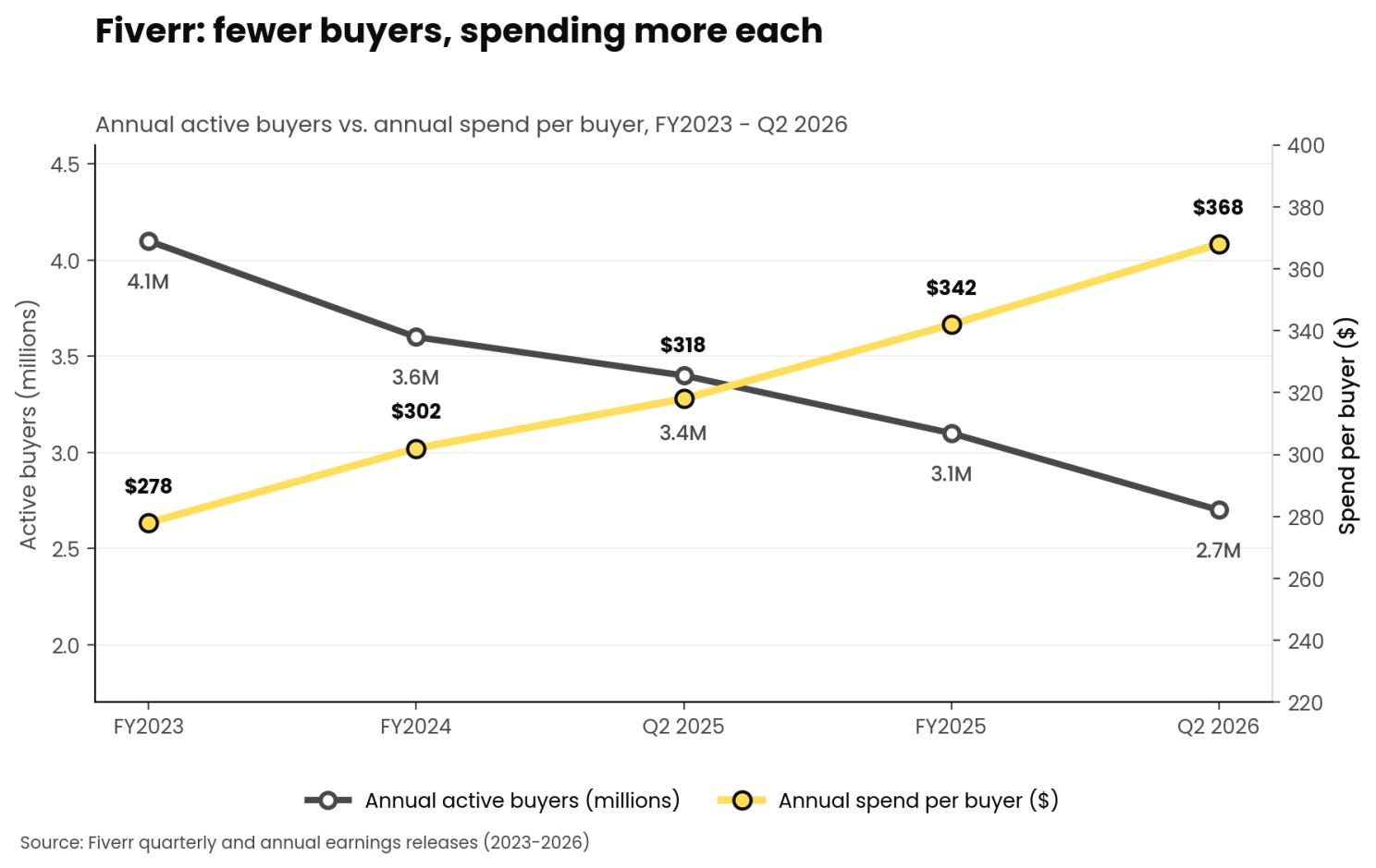
Fiverr’s own CEO, Micha Kaufman, called it “an accelerated evolution of the freelance economy” on the last earnings call. I’d put it less diplomatically. The cheap, high-volume, low-value work, the $5 logo, the quick 500-word blog post, is being quietly absorbed by AI. What’s left behind is longer, more complex, and worth paying for. Fiverr’s marketplace revenue actually fell 15.5% in Q2 2026 even as spend per buyer kept climbing. That’s not a company growing. That’s a company getting smaller and more expensive at the same time, which is its own kind of signal.
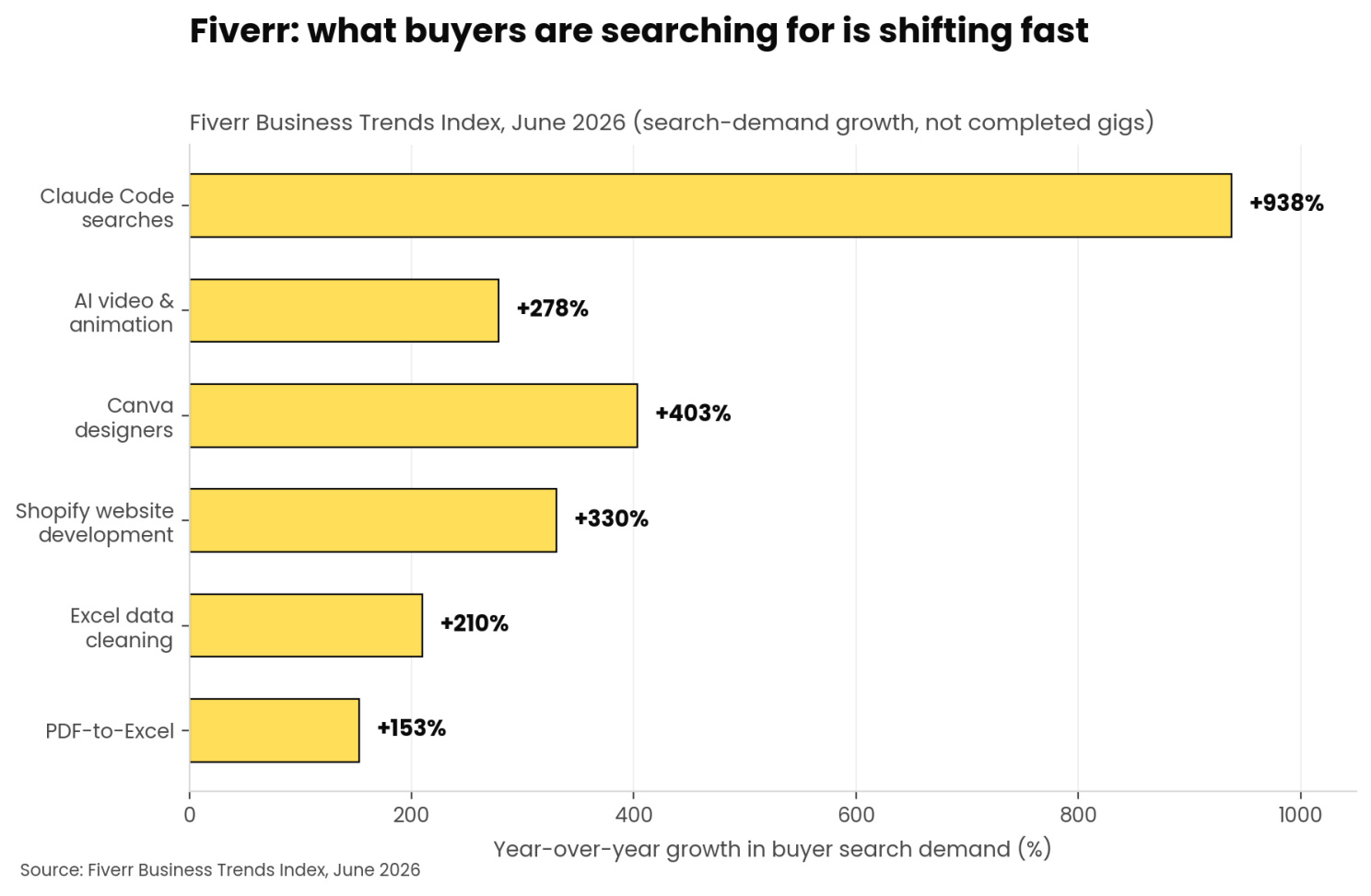
Fiverr doesn’t publish category-level job volume the way Upwork does (more on that gap in a minute), but its Business Trends Index shows what buyers are searching for, and it’s a fast-moving target. Claude Code searches up 938% year on year. AI video and animation up 278%. Canva designers up 403%. These are search-demand numbers, not completed gigs, so treat them as a leading indicator rather than gospel. Still, it tells you where the buyer’s attention is going.
Upwork: what the numbers say
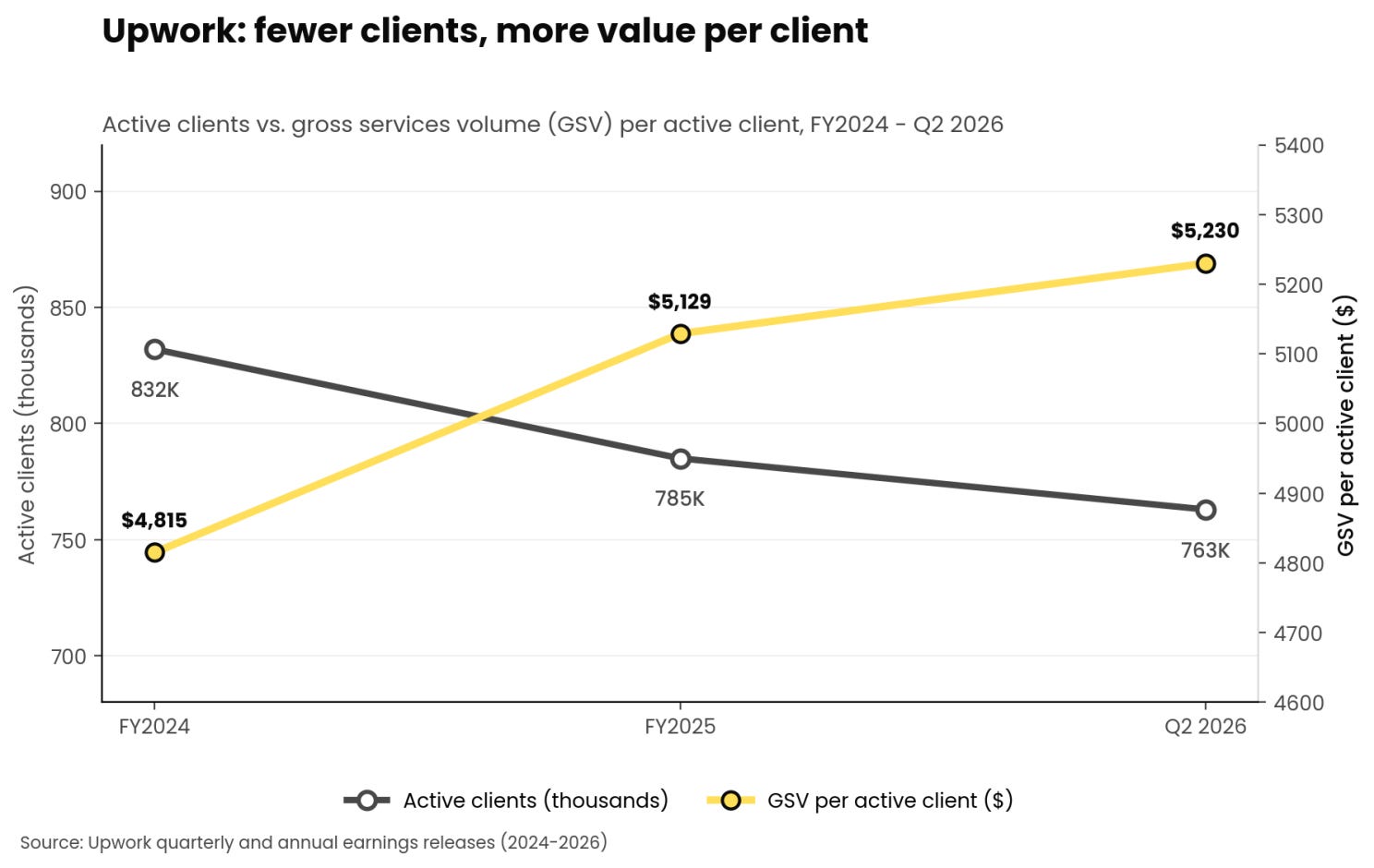
Same shape, different platform, better data. Upwork’s active client count went from 832,000 in 2024 to 763,000 by Q2 2026. GSV per active client (how much each remaining client actually spends) climbed from $4,815 to $5,230 over the same window.
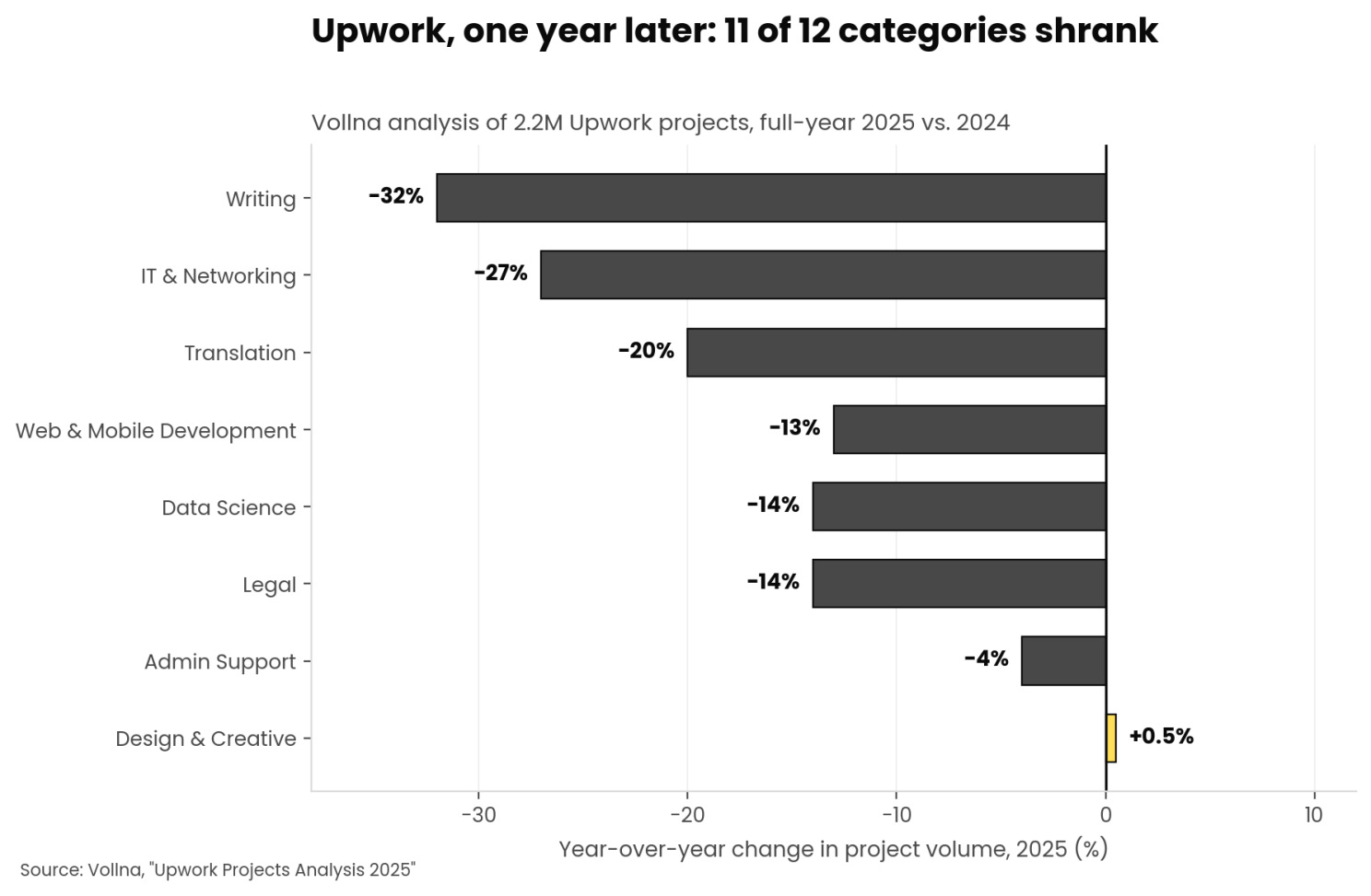
Where Upwork gets genuinely useful is category-level data, because two independent researchers actually counted the postings. Vollna scraped 2.2 million Upwork projects across 2025 and found 11 of 12 major categories shrank year on year. Writing dropped 32%. IT and Networking dropped 27%. Translation dropped 20%. Design & Creative was the lone category that grew, and only by half a percent.
This isn’t new. A year and a half earlier, an independent analyst named Henley Wing Chiu ran a similar exercise on 5 million Upwork postings and found almost the identical pattern: writing down 33%, translation down 19%, customer service down 16%, while video editing was up 39% and web design up 10%. Same three categories bleeding, roughly a year apart, on two separate datasets. That’s not noise. That’s a trend confirming itself.
Upwork’s own guidance got cut too, from $760-790 million down to $730-750 million for 2026, with management citing an accelerating pace of AI-related automation directly on the earnings call. When a company’s own leadership uses that phrase in a public filing, I take it at face value.
What did AI create, not just destroy?
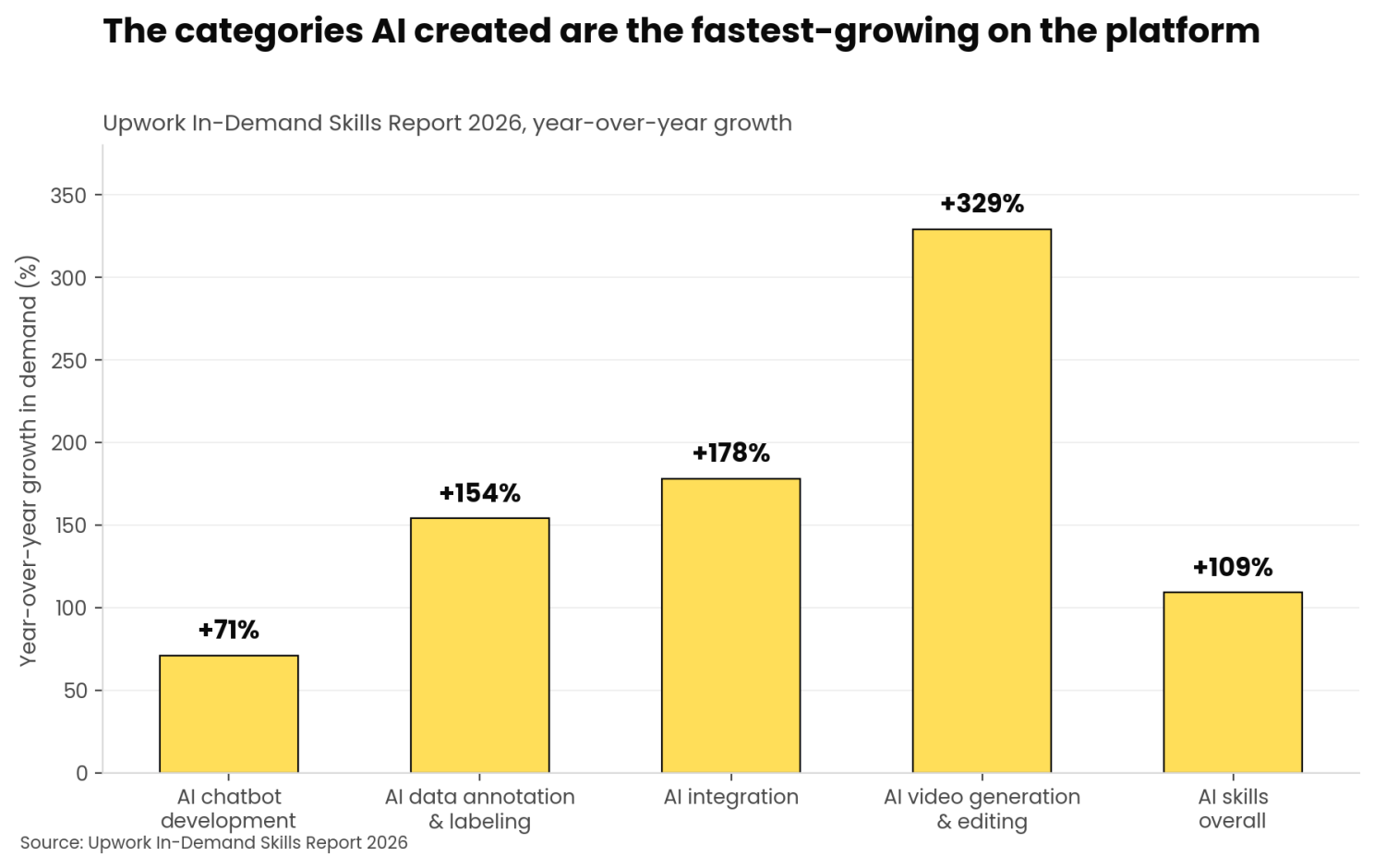
Here’s the part that gets lost in the doom narrative. AI didn’t just remove categories. It created new ones, and they’re growing faster than anything else on either platform.
Upwork’s 2026 In-Demand Skills report shows AI-related work overall up 109% year on year. AI video generation and editing is up 329%. AI integration is up 178%. AI data annotation and labeling is up 154%.
Freelancers doing this work earn about 34% more per hour than those who don’t, according to Upwork’s own Future Workforce Index. There’s a catch, though, and it’s worth sitting with. Basic prompt-writing gigs are already commoditizing at the bottom, some seller guides put the going rate as low as $25 an hour for generic prompt work, versus up to $200 an hour for someone who can actually build and prove an AI system’s ROI. The new category isn’t immune to the same sorting that hit writing and translation. It’s just younger.
What do the studies actually say?
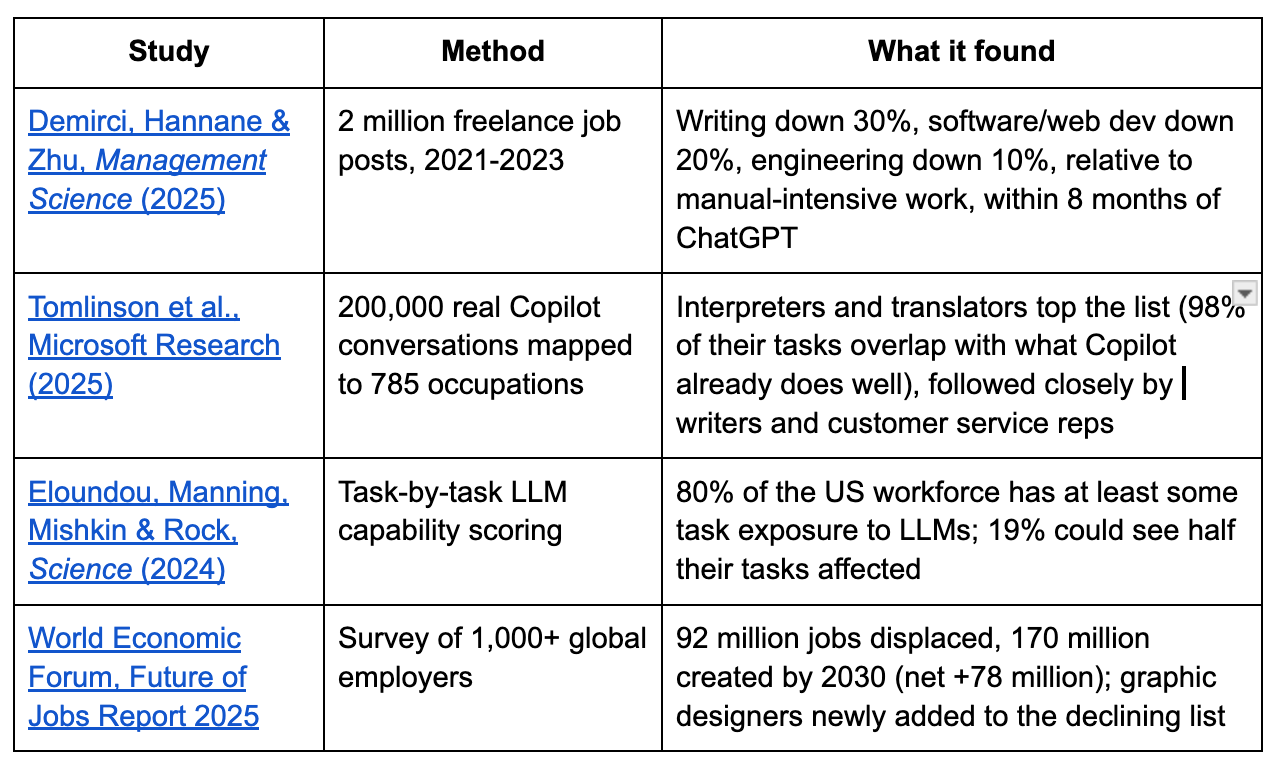
I went looking for academic backup, because platform data alone can be noisy (companies love a good narrative in an earnings call). Four studies, four completely different methods, mostly agree.
Demirci, Hannane & Zhu, published in Management Science in 2025, looked at 2 million freelance job posts from 2021 to 2023. Within 8 months of ChatGPT’s launch, writing jobs fell 30% relative to manual-intensive work, software and web development fell 20%, engineering fell 10%.
Tomlinson et al. at Microsoft Research took a different approach entirely. They mapped 200,000 real Copilot conversations onto 785 occupations. Interpreters and translators came out on top, 98% of their tasks overlap with what Copilot already handles well, followed closely by writers and customer service reps.
Eloundou, Manning, Mishkin & Rock, published in Science in 2024, scored jobs task by task for LLM capability. Their headline number: 80% of the US workforce has at least some task exposure to large language models, and 19% could see half their tasks affected.
The World Economic Forum surveyed more than 1,000 global employers for its Future of Jobs Report 2025. Their forecast: 92 million jobs displaced by 2030, 170 million created, a net gain of 78 million. Worth noting, graphic designers were newly added to the declining list this year.
Different data, different years, different institutions. Same three or four job families showing up at the top every single time: writing, translation, customer service, basic clerical work. I’d probably trust a single one of these less. All four pointing the same direction is harder to argue with.
Worth a hedge here. “Exposed to AI” and “actually lost the job” are not the same claim, and the Microsoft researchers are explicit about that themselves. Exposure is potential. What Vollna and Bloomberry measured on Upwork is closer to realized impact. The fact that both lines converge is the interesting part, not proof that every exposed job disappears tomorrow.
Where do the platforms and the studies agree?
Put the two data sets on top of each other and the picture gets simple fast. High-volume, high-exposure work (writing, translation, customer service, data entry) is shrinking on the platforms exactly where the academic studies said it would. High-volume, low-exposure work (video editing, most software development) is holding up or growing. And a small, currently low-volume corner (AI implementation, agents, automation) is where the growth is heading next.
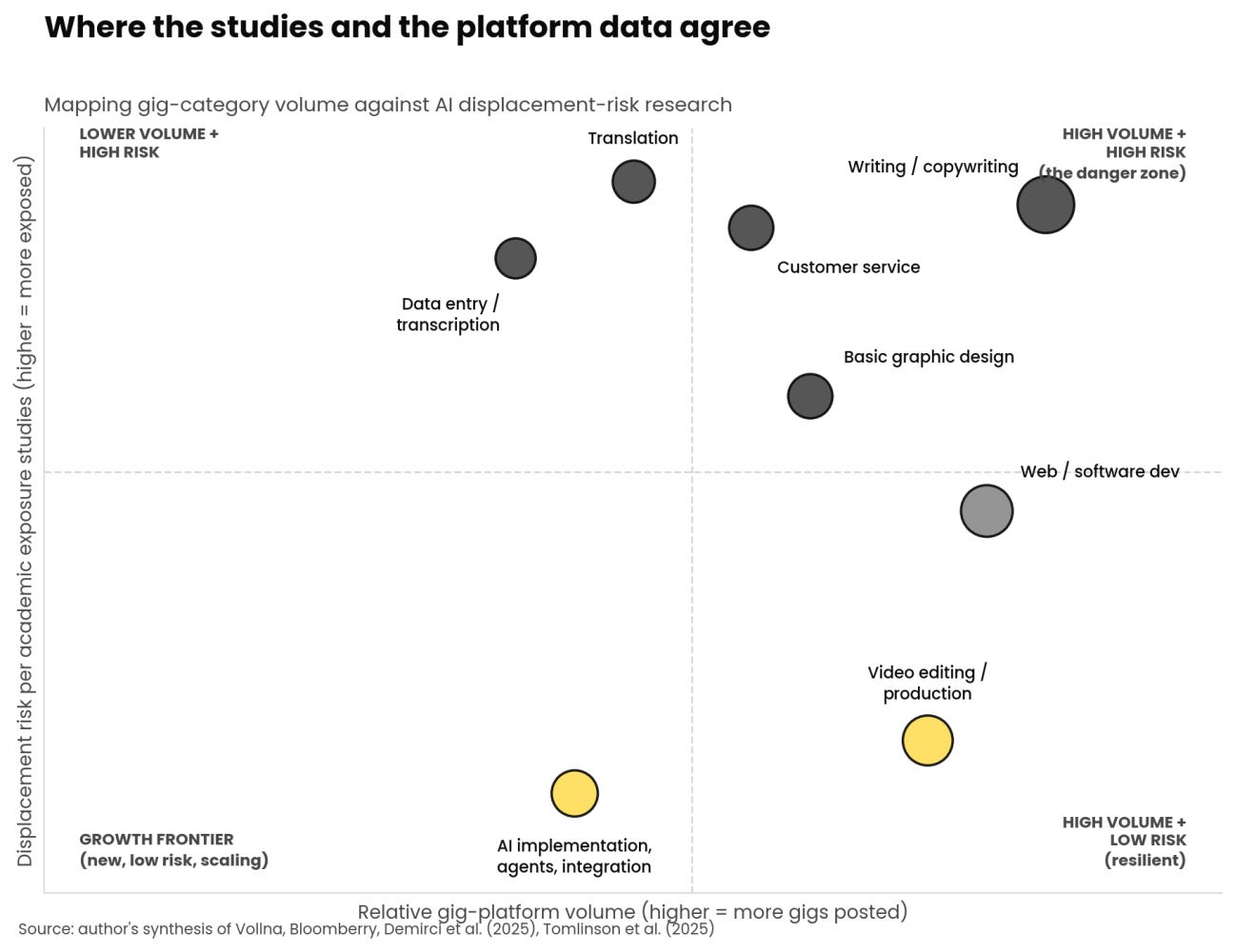
Basic graphic design and general web development sit in an uncomfortable middle. Not collapsing, not booming, just slowly migrating toward more complex, judgment-heavy versions of themselves.
So how does the future look?
It depends, honestly, on which half of the platform you’re looking at.
The bearish case is real and it’s happening now, not in some hypothetical future. Fiverr laid off 30% of its own workforce in September 2025 to go “AI-first.” A Ramp Economics Lab study tracking real company spending found that freelance-marketplace spend fell from 0.66% of total business spend in late 2021 to 0.14% by late 2025, a nearly fivefold drop, while spending on AI providers like OpenAI and Anthropic went from zero to almost 3%. More than half the businesses that used freelance platforms in 2022 had stopped entirely by 2025. That’s not sentiment. That’s where the money actually went.
The bullish case is just as real. Upwork’s own research found the share of US knowledge workers doing skilled freelance work jumped from 28% to 38% in a single year, and freelancers are adopting AI faster than full-time employees are. The global freelance platforms market is still projected to roughly grow fivefold by 2034.
And then there’s the part almost nobody quotes properly. The New York Fed looked at actual job postings data in May 2026 and found that AI exposure explains less than 10% of current job vacancies, and concluded plainly that AI “is not the main driver of the slowdown in hiring.” Anthropic’s own economists ran a similar study in March 2026 and found no systematic rise in unemployment among highly exposed workers, just a slower hiring rate for workers aged 22-25 in exposed jobs, somewhere between 13% and 19% depending on which data vintage you use.
So, both things are true. The commodity layer of freelancing is being hollowed out in real time. The skilled layer is growing, faster than the hollowing-out, at least so far. Probably, the honest read is that gig work isn’t disappearing. It’s re-sorting itself by who can do something an AI genuinely can’t do yet, which is judgment, taste, and accountability for the outcome.
My take
Every industrial revolution I’ve read about follows the same shape. A lot of jobs disappear exactly as we knew them. A lot of jobs nobody had thought of yet show up to replace them. Bankers were terrified of ATMs in the 1950s. There are more banking jobs today than there were then. SEO didn’t exist before search engines did. Somebody now makes a very good living doing it.
Here’s the one thing I’m sure about. Nothing here is permanent. Not the categories that are shrinking, not the ones that are growing, not even the “safe” list. We adapt, we survive, we find a way through. That part of the pattern has never once failed to repeat.
If your work sits in the danger zone on that quadrant chart above, the honest move is to think, soon, about what you want to do next, and act on it intentionally. Not out of panic. Out of awareness. Resistance doesn’t slow this down, it just spends your runway on denial instead of preparation. And if your job currently looks secure, don’t get comfortable either. Three months in AI is a long time. The list of “safe” jobs from six months ago is already shorter than it was.
One thing I’d say with real confidence. Anything built purely on creating digital content, text, audio, video, image, carries some level of risk right now, whatever the specific job title on top of it. And traders, plumbers, electricians, anyone whose job requires being physically present and making a judgment call with their hands, are about as safe as it gets. For now. Until the robotics side of this catches up, and it will, eventually. Just not this year, and probably not next year either.
The only constant is change. That was true before AI showed up, and it’ll be true long after this particular wave settles into being normal.
Sources
Fiverr, Second Quarter 2026 Results
Fiverr, Business Trends Index, June 2026
Upwork, In-Demand Skills Report 2026
Upwork, Future Workforce Index 2026
Vollna, Upwork Projects Analysis 2025
Bloomberry (Henley Wing Chiu), The jobs being replaced by AI
Demirci, Hannane & Zhu, “Who Is AI Replacing?”, Management Science (2025)
Tomlinson, Jaffe, Wang, Counts & Suri, “Working with AI”, Microsoft Research (2025)
Eloundou, Manning, Mishkin & Rock, “GPTs are GPTs”, Science (2024)
World Economic Forum, Future of Jobs Report 2025
Ramp Economics Lab, “Payrolls to Prompts”
Federal Reserve Bank of New York, Do Job Postings Show Early Labor-Market Effects of AI?
Anthropic, Labor market impacts of AI: A new measure